REVIEW · SPLIT
Private Walking Tour in Split Old Town (ENG, FRA, ITA, ESP)
Book on Viator →Operated by Sanja - Tour Guide in Split · Bookable on Viator
Split’s Old Town clicks into place quickly.
This private walk gives you a clear map of what you’re seeing, from the Roman backbone of town life to the medieval and later layers that followed. I like that it’s guided by Sanja (a licensed local with a Master’s degree), and the pacing keeps the story understandable instead of turning into a facts dump.
Two things I especially like: you get a private experience with a guide who can adjust to your questions, and the tour is built around Diocletian’s Palace so you grasp the big idea before you wander on your own. One small consideration: the Diocletian Palace Substructures have an extra entrance fee of €10 per person, so it’s worth factoring that in early.
In This Review
- Key Highlights Worth Booking
- Riva Promenade: Start With the Best Split Backdrop
- Diocletian’s Palace: The Roman Complex You’ll Actually Understand
- Substructures Visit: Best-Preserved Clues Underground
- Cathedral of Saint Domnius: Emperor’s Burial Meets Daily Life
- Triklinij and the Emperor’s Dining Hall Complex
- Vestibulum and the Acoustics of Dalmatian Singing
- Peristyle: The Imperial Square, the Mausoleum View, and an Egyptian Sphinx
- From Temple of Jupiter to the Golden Gate: Gates, Gods, and Fortifications
- Iconic Statues and Main Squares That Define the Old Town
- Fish Market Timing, Marmontova Ulica, and Prokurative’s Austro-Hungarian Flavor
- Practical Details: Group Size, Duration, and Real-World Value
- Who This Tour Fits Best (and Who Might Want Something Different)
- Should You Book This Split Old Town Walking Tour?
- FAQ
- What’s the meeting point for the Split Old Town private walking tour?
- How long is the tour, and what time does it start?
- Is the tour entrance fee included for the Diocletian Palace Substructures?
- What language is the tour offered in?
- Is this a private tour or will I join other groups?
- What happens if the weather is poor?
Key Highlights Worth Booking
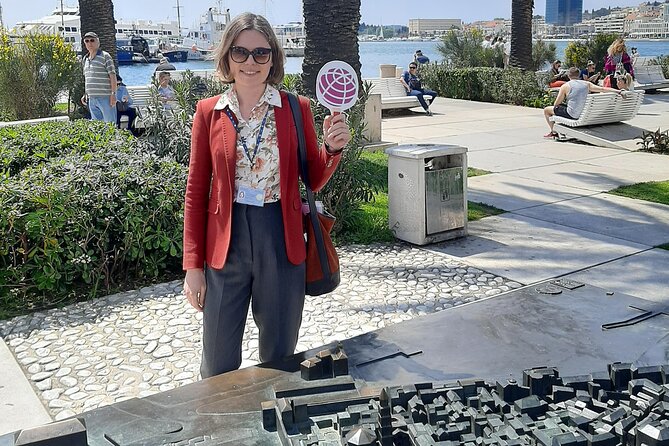
- Master’s-degree licensed local guide (Sanja): You’re not just hearing dates, you’re getting explanations that help you read the sites on the street.
- Old Town orientation in 1 hour 45 minutes: You leave with a mental map that makes later self-guided wandering easier.
- Diocletian’s Palace, explained as a living layout: You’ll see how the Roman architecture is used today, not just admired as ruins.
- Substructures internal visit (extra €10): This is the best-preserved part for understanding how the palace worked.
- Photo-friendly viewpoints at key gates and squares: You pass major landmarks like the Golden Gate, Grgur Ninski statue, and central squares without rushing.
Riva Promenade: Start With the Best Split Backdrop
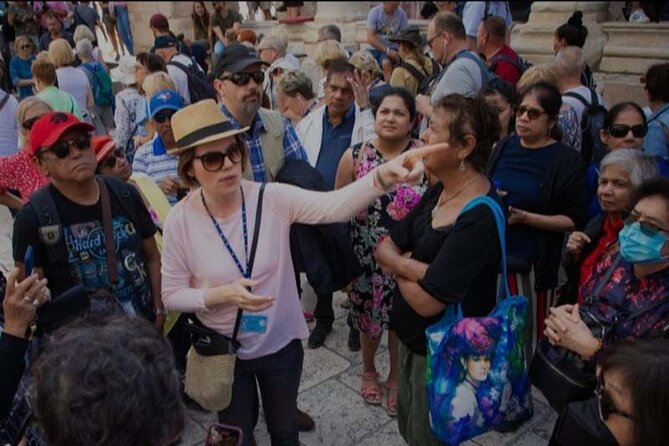
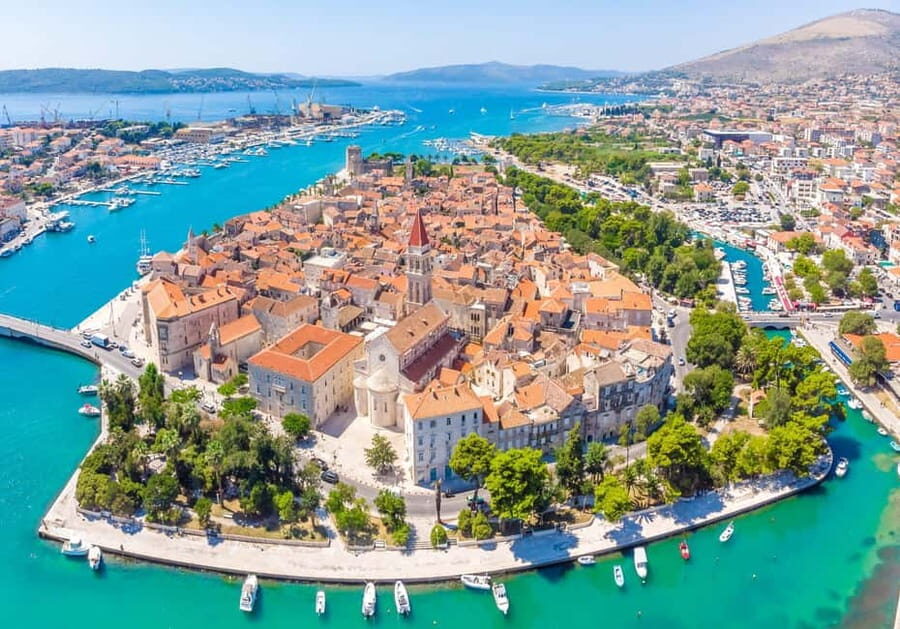
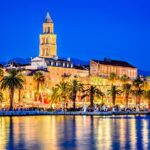
You’ll meet at the Riva promenade (Obala Hrvatskog narodnog preporoda 22) at 9:00 am. From the start, the location does half the work for you. Riva is where you can take in the sweep of the Roman palace walls, the medieval town around them, and the greenery of Marjan hill/park in the same glance.
This matters because Split can feel like a maze once you’re inside the Old Town. Standing at the Riva first is a smart move: it helps you connect the buildings you’ll see next with the bigger setting they sit in. The tour also ends back at the same meeting point, so you don’t feel like you walked yourself into a dead-end.
You can also read our reviews of more tours and experiences in Split.


Diocletian’s Palace: The Roman Complex You’ll Actually Understand
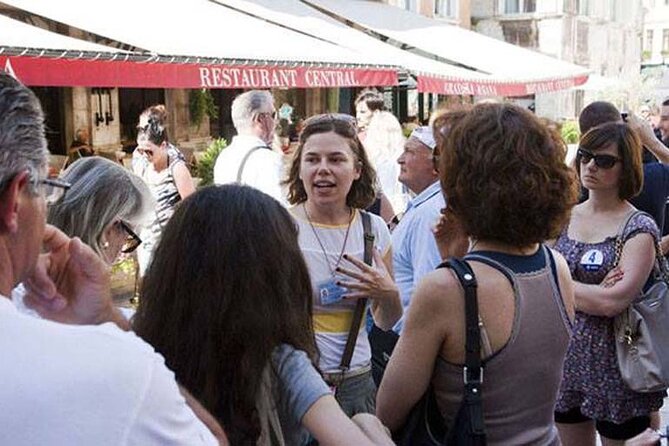
Diocletian’s Palace is the heart of this tour, and it’s treated that way. You’ll spend time walking through the palace area (about 9 acres) and visiting multiple internal points while learning how the Roman design connects to what you see today.
A big value here is how the guide frames the palace. It’s not presented as frozen-in-time stone. You’ll hear how this Roman piece of architecture is used for modern purposes. That makes a difference: you stop treating everything as a monument and start noticing the logic of corridors, squares, and entrances.
The pace is also built for comprehension. You’re not expected to sprint from spot to spot. The visit time is about 10 minutes at the palace stop in the plan, but you’ll feel you’re moving at “learning speed,” not “checklist speed.”
Substructures Visit: Best-Preserved Clues Underground
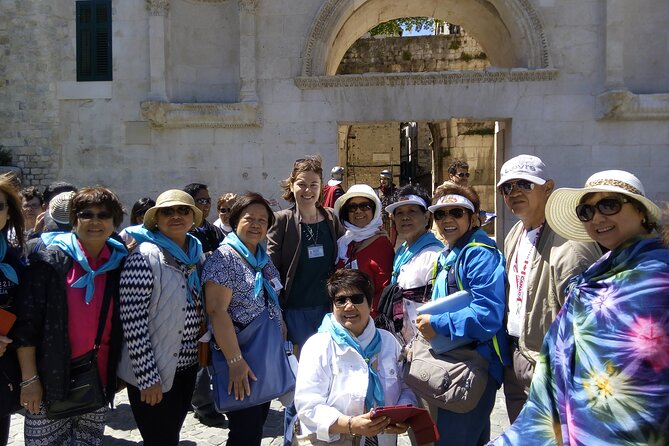
One of the most important moments comes at the Diocletian Palace Substructures (an internal visit). This part is highlighted for a reason: it’s described as the best preserved section of the Roman palace, and it’s where you get the strongest sense of construction, architecture, and the palace’s former function.
Here’s the practical bit: admission for the substructures is not included, and the entrance fee is €10 per person. If you’re deciding whether to do this tour, don’t ignore that. If you care about how buildings worked, this stop is the one that rewards curiosity the most.
If you’d rather only look from the outside, this is the one element you might skip on cost grounds later. But if you’re already paying for a guided explanation, it’s usually the best place to spend the extra money—because it’s hard to “get” this section without context.
Cathedral of Saint Domnius: Emperor’s Burial Meets Daily Life
Next up is the Cathedral of Saint Domnius, with an external visit. This site is special because it’s tied directly to the emperor’s burial—your guide will point out that the cathedral sits alongside the emperor’s mausoleum.
What I like about this stop is that you get a sense of continuity. Even though it’s presented externally in the tour plan, the context matters. The cathedral isn’t just another church in your itinerary; it’s part of the palace story, showing how imperial space became religious and public space over time.
Triklinij and the Emperor’s Dining Hall Complex
You’ll also visit Triklinij, connected to the emperor’s apartment and especially the dining hall complex. This is one of those stops that can sound small on paper—until you understand what it represents.
Dining is politics and power in every era. In this context, Triklinij helps you imagine the palace not just as a fortress, but as a place where people gathered, ate, met, and projected authority. Even if your visit time is brief (about 5 minutes in the plan), the explanation gives the stop meaning instead of turning it into another “stand and look” moment.




Vestibulum and the Acoustics of Dalmatian Singing

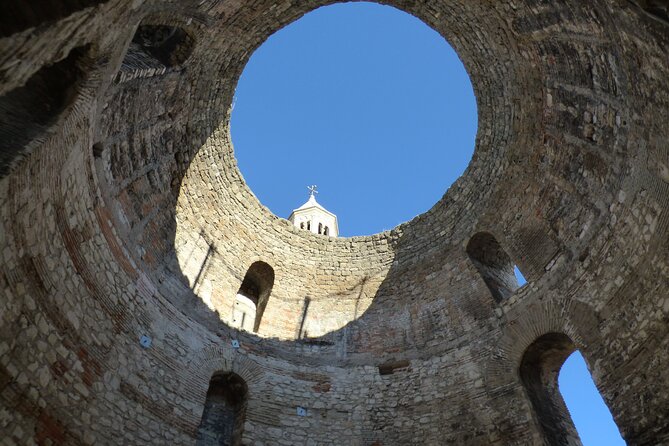
Another standout is the Vestibulum of Diocletian’s Palace. The plan notes that it’s the emperor’s chamber area and that, in summer months, traditional Dalmatian singing can sometimes be heard there because of the acoustics.
Even if you don’t catch music on your specific day, the point is worth knowing: this is a space that can feel different depending on timing and season. When a guide tells you why a place sounds the way it does, it makes your walk more than just visual sightseeing.
Peristyle: The Imperial Square, the Mausoleum View, and an Egyptian Sphinx
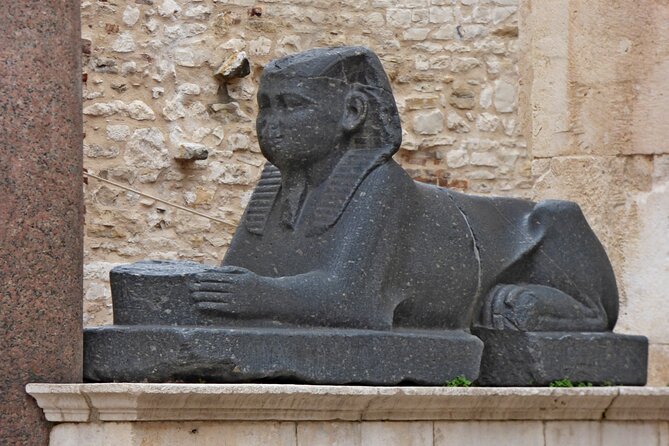
Then you arrive at the Peristyle—described as the imperial square in the palace. This stop is set up for two things: understanding the square’s importance and taking in the views.
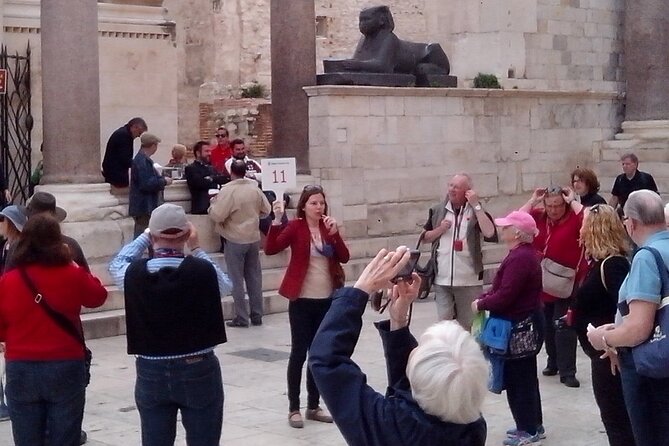
You’ll admire sightlines toward the emperor’s Mausoleum, which is now the Cathedral with the belltower. You’ll also see an original Egyptian sphinx. That combination—Roman power, a later religious landmark, and an Egyptian artifact—shows how wide Split’s story really is.
The peristyle stop is about 10 minutes in the plan, and it works well as a “breather” moment after the more architectural substructures and inner spaces. You get context and you get a look around.
From Temple of Jupiter to the Golden Gate: Gates, Gods, and Fortifications
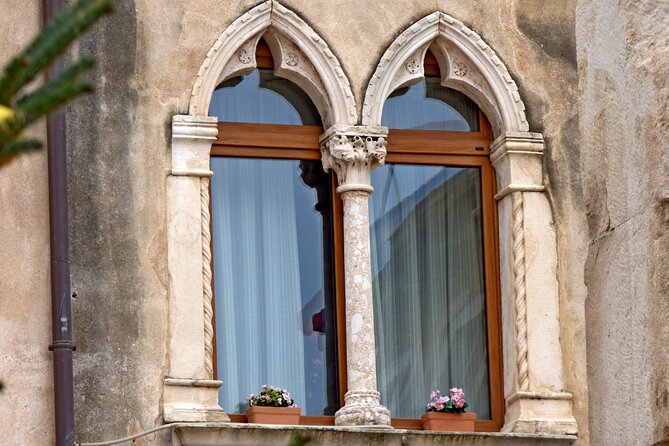
You’ll see the Temple of Jupiter externally—where the main Roman god was worshipped. You’ll also pass through the Golden Gate, which is the main gate into the Roman palace. From outside, you’ll admire full views of the fortifications.
These are short stops on the schedule, but they matter. Gates tell you how people moved between worlds: outside city life and inside palace space. Temples and gods help you understand what the palace wasn’t only for. It wasn’t just administration; it also reflected belief and authority.
Iconic Statues and Main Squares That Define the Old Town
After the Roman core, the walk starts layering in medieval Split.
You’ll see the Grgur Ninski statue, an iconic symbol of Split, and then head to Narodni Trg, the main square of medieval Split where the guide discusses its importance. Nearby, there’s Old Town Hall from the Republic of Venice era on Pjaca square.
From there, you visit Fruit’s Square (Trg Brace Radic), which features a huge tower once part of medieval fortifications. The guide also talks about noble families from that time and why they mattered to the town. You’ll end this square stretch at the Marko Marulic sculpture, a famous writer that locals are proud of.
These stops may look like simple photo breaks from the outside, but with an explanation, they turn into a map of who held power and why people clustered where they did. That’s one of the biggest reasons a guided orientation tour pays off.
Fish Market Timing, Marmontova Ulica, and Prokurative’s Austro-Hungarian Flavor
You’ll also pass by or visit the Split Fish Market, which has been in the same location since the 19th century—but it’s open only in the morning. Since your tour starts at 9:00 am, you have a real shot at seeing it at active hours, depending on the day.
Next is Marmontova Ulica, a famous street connected to Split during French rule in the 19th century. After that, you’ll reach Prokurative, the square from the time Split was part of the Austro-Hungarian monarchy in the 19th century.
This is where the tour becomes more than “Roman, done.” It gives you a quick, readable timeline. You see how new rulers and new eras left physical traces in street layout and public space. It also helps you know what you’re looking at if you choose to keep wandering later.
Practical Details: Group Size, Duration, and Real-World Value
This is priced at $156.19 per group for up to 15 people, and it runs about 1 hour 45 minutes. Because it’s private, your group size is only your group—no mixing with strangers. That’s useful in Split, where families, couples, and solo travelers all move at different speeds.
Let’s talk value in plain terms. If you’re a couple, the cost per person is higher than if you roll in as a small family or a group of friends. If you’re four people, the price starts to feel very reasonable—exactly the kind of affordability that makes a private tour feel smarter than squeezing into a larger group tour.
Also, you’ll get a mobile ticket. The tour ends back at the starting meeting point, which makes planning the rest of your day simpler. And the guide is the licensed local with a Master’s degree—meaning you’re paying for interpretation, not just a walk from point A to point B.
Who This Tour Fits Best (and Who Might Want Something Different)
This private walking tour is a great fit if you want to:
- get your bearings fast in Split Old Town
- understand Diocletian’s Palace without missing the key details
- ask questions and go at your own pace
- appreciate architecture and city layers (Roman, medieval, and later eras)
It’s also described as having good pace for kids, which tells me it’s managed thoughtfully rather than dragging. If you’re traveling with mixed ages, a private guide is often the safer bet than a long, rigid group tour.
The main “watch-out” is the substructures entrance fee (€10 per person). If you’re on a tight budget, that fee will matter. If you’re okay paying for the best-preserved palace section, you’ll likely feel the extra cost is justified.
Should You Book This Split Old Town Walking Tour?
If you want the shortest path to understanding Split—especially the Roman core—this is an easy yes. The strongest reason to book is the structure: you start with a wide-view orientation at Riva, then focus on Diocletian’s Palace in a way that connects architecture to real meaning, then finish with the medieval and later public spaces that shape the Old Town.
I’d book it if you care about context and you like learning while walking. I’d think twice only if you already know you don’t want to pay for the Diocletian Palace Substructures entrance. Otherwise, this is the kind of tour that makes the rest of your day in Split feel more organized, not just more crowded.
FAQ
What’s the meeting point for the Split Old Town private walking tour?
The tour meets at Obala Hrvatskog narodnog preporoda 22, 21000 Split, Croatia. It also ends back at the same meeting point.
How long is the tour, and what time does it start?
It lasts about 1 hour 45 minutes and starts at 9:00 am.
Is the tour entrance fee included for the Diocletian Palace Substructures?
No. The Diocletian Palace Substructures have an additional entrance fee of €10.00 per person.
What language is the tour offered in?
The tour is offered in English. The tour title also lists French, Italian, and Spanish options.
Is this a private tour or will I join other groups?
It’s a private tour/activity. Only your group participates.
What happens if the weather is poor?
This experience requires good weather. If it’s canceled due to poor weather, you’ll be offered a different date or a full refund.
If you want, tell me your group size and your travel month, and I can help you judge whether the substructures stop is worth prioritizing for your day.