REVIEW · SPLIT
Split & Diocletian Palace Historical Walking Tour
Book on Viator →Operated by Ancient Tours · Bookable on Viator
A palace, a harbor, and Roman stones in 90 minutes. This Split walk is built around Diocletian’s Palace as a living maze, so you understand where everything is and why it still matters. I like that it connects the palace to daily city life, especially around the waterfront.
What really works for you is the tight 5-person option (when available) and the focused stops that cover the most important palace spaces without dragging you through every room.
One thing to watch: a few highlights along the route have extra entry fees and the overall experience depends heavily on how clearly the guide speaks.
In This Review
- Key Things You’ll Notice on This Walk
- Split’s Diocletian Palace, Explained Like a Real Place
- Start at the Peristyle: Your Palace Map in One Spot
- Substructures: The Under-Level Story You Usually Miss
- Riva Harbor Views and the South Wall Angle
- Fruit’s Square (Trg Brace Radic): Art, Language, and City Layers
- The Last Ancient Roman Temple and Diocletian’s Private Spaces
- A Venetian Museum Building and the Cathedral in the Mausoleum
- Grgur Ninski Statue and the Golden Gate: Where Croatian Identity Shows Up
- Riva Harbor Again: The Bronze Palace Model and Waterfront Memory
- Price and Value: What You’re Really Paying For
- Who This Tour Fits Best (and Who Might Prefer Another Plan)
- How to Make the Most of Your 90 Minutes
- Should You Book This Split Walking Tour?
- FAQ
- How long is the Split & Diocletian Palace Historical Walking Tour?
- What is the price per person?
- Are there small group and regular group options?
- What languages is the tour offered in?
- Is admission included for all stops?
- Can I cancel for free?
Key Things You’ll Notice on This Walk
- Peristyle first: the central square helps you map the whole palace fast
- Substructures focus: you’ll learn what the under-levels did, while skipping the museum portion
- Harbor + palace wall: Riva Harbor viewpoints tie the palace to Split’s waterfront
- Language markers: you’ll see the Grgur Ninski statue and Gregory of Nin themes
- Mixed inclusions: most stops are free, but some entry at key entrances/models isn’t included
Split’s Diocletian Palace, Explained Like a Real Place
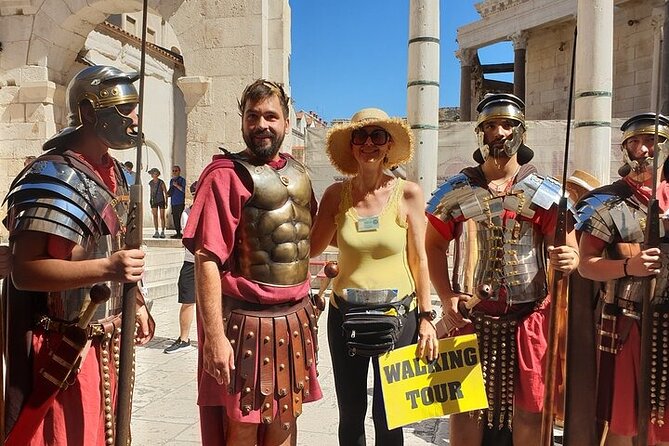
If you’re short on time in Split, this is a smart way to get the palace without turning your day into a checklist. The pacing is quick but not rushed. You spend enough time at each stop to orient yourself, then move on while the palace layout is still fresh in your head.
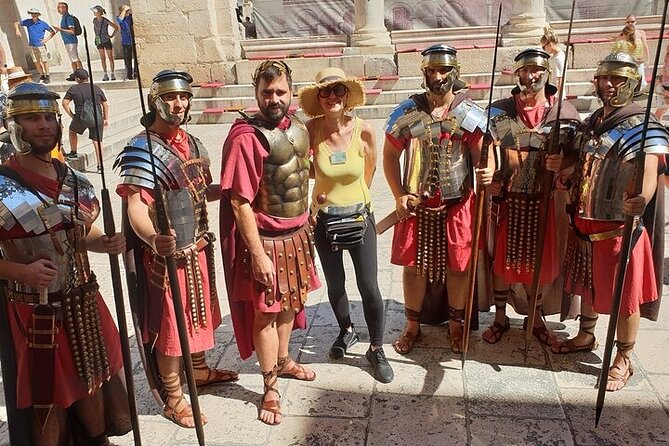
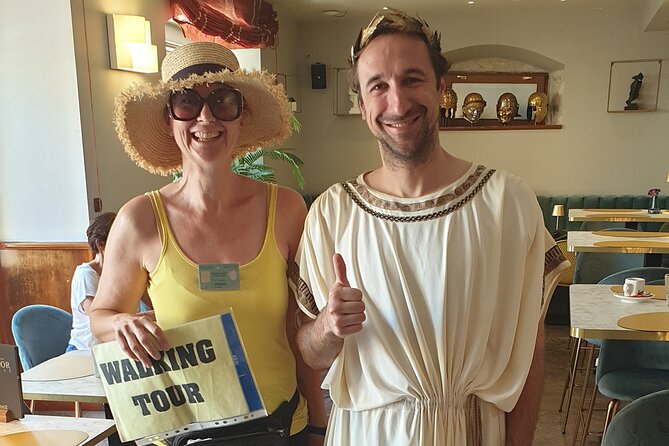
You’ll also be walking with an educated guide, and that matters here. Diocletian’s Palace can feel like a pile of old stone unless someone helps you read it. This tour does that by moving through the spaces that connect to each other—so you see how the palace worked as a whole.
The price, $156.17 per person, feels steep only until you look at what’s actually included. A guided 90-minute walk with a small-group option and multiple free-to-enter stops adds up, especially in a city where self-guided wandering can leave you guessing.
You can also read our reviews of more tours and experiences in Split.


Start at the Peristyle: Your Palace Map in One Spot
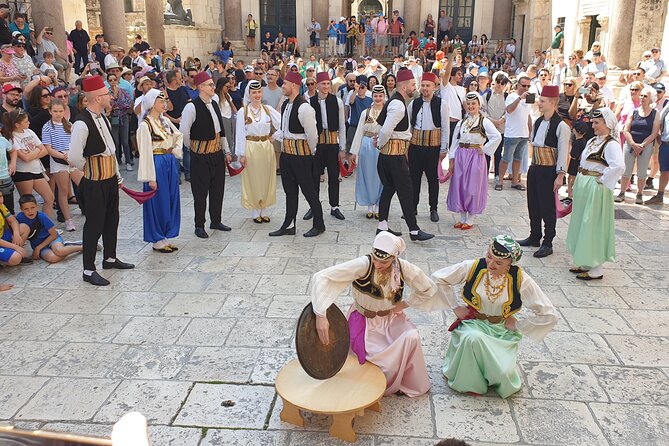
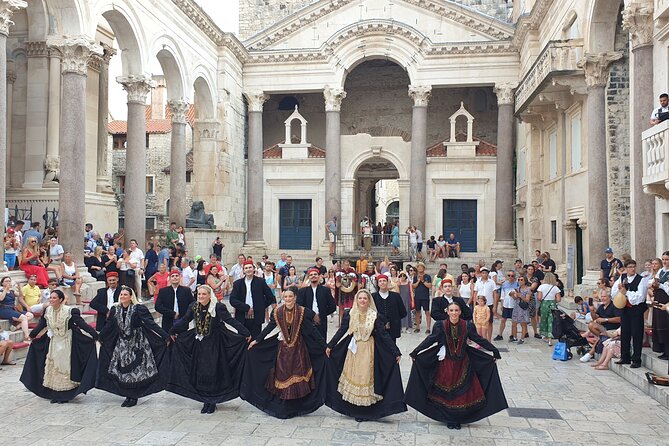
The tour begins at the Peristyle, the central square of Diocletian’s Palace. This is the one place that helps everything else make sense. Because it’s the hub, you can quickly understand how the palace routes connect and where major areas sit relative to one another.
Even if you only have a phone camera, this is your first “oh, I get it” moment. The Peristyle is one of those spots where photos look good because the layout is already doing the work—symmetry, columns, and that sense of a place designed for movement.
Practical tip: arrive a few minutes early. With 90 minutes total, you want your first stop to feel unhurried. And if you’re sensitive to crowds, plan your photos at a slight angle rather than trying to stand dead-center.
Substructures: The Under-Level Story You Usually Miss
Next you head to the Diocletian Palace substructures. These are the areas beneath the main spaces, and they’re where the tour really earns its value. You’ll learn about the history of the palace construction and how these spaces functioned over time.
One key note is that you won’t visit the museum part of the substructures during the tour. That’s a good thing for two reasons. First, it keeps the walking rhythm. Second, it gives you the option to return afterward if you want deeper museum detail without buying a longer tour.
Why this matters: most people see the palace from street level and think they’ve “done” it. The substructures remind you this is an engineered complex, not just a scenic ruin. You leave with a more solid mental model of the palace.
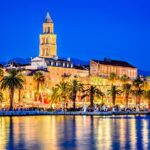
Riva Harbor Views and the South Wall Angle
Then the walk shifts to the Riva Harbor area, where you’ll learn about the waterfront of the city and the south wall of the palace. This is where the palace stops being a museum exhibit and starts feeling like part of everyday life.
Standing near the water also changes how you perceive the palace walls. From here, you can see how the built form faces the harbor and how Split’s modern street life layers over older stone. For photos, it’s a nice break from tight corridors—more sky, more perspective, and fewer “hold your phone over the crowd” moments.
This stop is short, but it’s useful. It ties the palace to geography, not just architecture.
Fruit’s Square (Trg Brace Radic): Art, Language, and City Layers
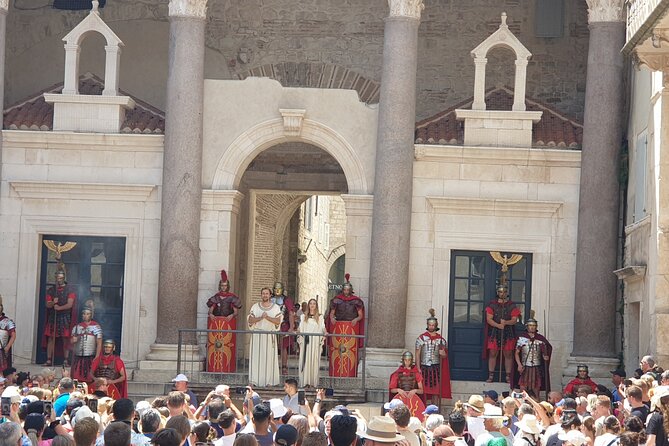
At Fruit’s Square (Trg Brace Radic), you’ll get a quick hit of cultural history. The tour includes the Old Venetian citadel feel of the area and the sculpture of Marko Marulić.
Marulić is the kind of figure that helps you understand why Split doesn’t just preserve Roman-era structures. The city’s identity keeps getting rewritten through later eras. Even if you’re not a museum person, a good sculpture moment can be a shortcut to understanding local pride and memory.
The time here is brief, so don’t try to do a full detour photo session. Treat it like a checkpoint: look, learn, snap one good photo, and keep moving.




The Last Ancient Roman Temple and Diocletian’s Private Spaces
A standout stretch of the tour takes you through several linked “palace life” stops—places that help you imagine how Diocletian’s world functioned day to day.
First, you’ll see the last remaining ancient Roman temple in the palace. This is one of those sights where the importance is not just the age, but the fact that it’s still here when so much else is altered, reused, or gone. If you like your history tied to visible structures, this stop is worth the quick pause.
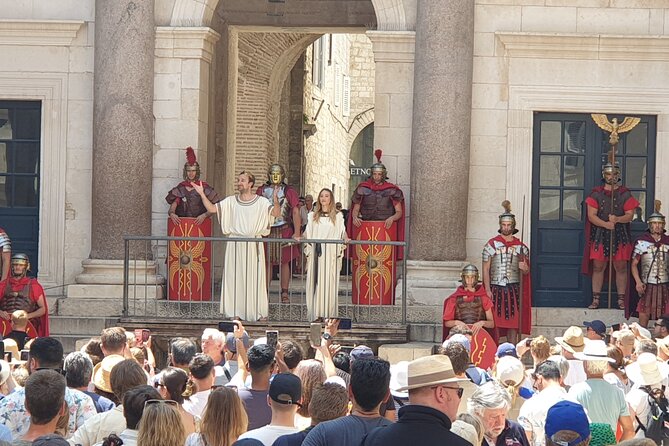
From there you move into the Vestibulum of Diocletian’s Palace, described as the entrance hall of Diocletian’s personal quarters. The tour points out the vestibule of emperor Diocletian, and you might even hear traditional Dalmatian singing. You can’t count on it in the abstract, but the way the tour frames the space makes it feel like a living tradition, not only a static artifact.
You’ll also reach Triklinij, with remains and a partial reconstruction of Diocletian’s personal walkway and dining hall. Dining spaces can be hard to picture when you’re looking at stone. A tour that explains how the room relates to movement and gathering makes it easier to visualize the daily routine.
Photo tip: for vestibule and dining-hall areas, keep your photos a little wider than usual. These spaces read better when you capture more of the surrounding angles and not only a close-up of one feature.
A Venetian Museum Building and the Cathedral in the Mausoleum
After that, the walk brings in the later layers that make Split feel like a city built over time. You’ll see a 15th-century Venetian palace that is now the museum of the City, and you’ll also come to the cathedral in the mausoleum of emperor Diocletian.
Even if you don’t go inside on this specific walk, simply seeing how these religious and museum spaces sit within the palace complex helps you understand why people still live, worship, and study here. You’re not just touring “old ruins.” You’re walking through a place that kept being used.
If you’re the type who likes to make a plan while you’re walking, this is a good moment to decide what you might revisit afterward. The tour keeps you oriented first, so later you know what’s worth your time if you want deeper indoor stops.
Grgur Ninski Statue and the Golden Gate: Where Croatian Identity Shows Up
One of the most memorable parts comes near the north and main entrance zones of the palace.
You’ll see the Grgur Ninski Statue made by Meštrović, positioned in front of the north gate of Diocletian Palace. The tour connects this figure to the father of the Croatian language, which gives the sculpture a sharper meaning than just its artistic presence. It’s a reminder that the palace isn’t only Roman. It’s also a stage for more recent cultural milestones.
Then you move to the Golden Gate, the main entrance to Diocletian’s Palace. Here you’ll learn about it and see the statue of Gregory of Nin, and how he matters to history and language.
Important for your planning: admission for the Golden Gate area isn’t included. So, if you’re hoping for a specific interior visit or a fully ticketed experience at the entrance, you’ll need to account for that in your budget. The good news is that the tour still gives you the context around why this entrance is important.
Riva Harbor Again: The Bronze Palace Model and Waterfront Memory
The tour ends with another stop back at Riva Harbor, focusing on a bronze model of Diocletian’s Palace and the history of Split’s beautiful Riva promenade.
This is a clever close. Early on, you’re learning the palace as you walk through its spaces. At the end, the bronze model helps you assemble what you saw into a single overview. It’s the kind of “wait, now I can picture the whole thing” moment that makes the rest of the tour stick.
You should also know that the model experience at this stop has admission not included. If you’re budgeting tightly, plan your decision. If you’ve got room for it, the model is a great way to translate your 90-minute route into something you can recall later.
Price and Value: What You’re Really Paying For
At $156.17 per person, this tour is in the “paid guidance” category. It’s not the cheapest way to see Split’s oldest streets, but it’s often good value if you want your time to feel efficient.
Here’s what you get that most solo wandering doesn’t give you:
- an educated guide who explains what you’re seeing in each key palace area
- a logical sequence through the palace hub, substructures, key chambers, and entrance zones
- a mix of free stops and optional paid extras so you control how deep you go
- the option of a small group tour (max 5), which usually means you can ask questions and hear the guide better
The other value element is pacing. At about 1 hour 30 minutes, you get enough structure to see the big pieces without losing the rest of your day to walking fatigue. In Split, that’s not a small thing.
Who This Tour Fits Best (and Who Might Prefer Another Plan)
I think this tour is ideal if you:
- want Diocletian’s Palace orientation fast
- like walking with a guide because it turns stone into meaning
- plan to do a few additional self-guided stops afterward (the tour often nudges you toward what’s worth revisiting)
- prefer smaller groups when possible
You might want a different option if:
- you’re very price-sensitive and don’t want any chance of extra admission at entrance/model stops
- you’re worried about hearing the guide clearly and you know you’ll have trouble with softer voices
One practical approach: if you book the small group option, you’ll usually feel less rushed and more connected to the guide’s explanation. If you choose the regular group, show up early and pick a spot where you can hear without craning.
How to Make the Most of Your 90 Minutes
Split’s palace streets can feel crowded, especially in peak hours, so your best friend is a simple plan.
- Wear comfortable shoes. You’ll be moving between interior-feeling spaces and waterfront areas.
- Bring a phone with enough battery. You’ll take close-up photos at several palace sections and entrances.
- Have a loose decision ready about paid add-ons. Since some parts are not included, decide before you get there so you’re not guessing mid-walk.
- If you want quieter photos, consider a departure time that has less foot traffic. Evening options can also change the vibe, since the lighting and crowd flow are different.
Should You Book This Split Walking Tour?
If you’re choosing between wandering on your own and paying for guidance, I’d lean toward booking—mainly because the tour helps you understand the palace layout in a short window. The Peristyle start, the substructures explanation, and the language-themed stops at the gates give you both geography and culture, not just photos.
Book it if you want a well-paced introduction and you like hearing stories tied to specific spaces. Consider passing or choosing another option if you dislike extra ticketed stops or you tend to struggle hearing guides in groups.
In short: it’s a strong way to get your bearings in Split’s oldest core, then keep enjoying the city with your own freedom.
FAQ
How long is the Split & Diocletian Palace Historical Walking Tour?
The tour lasts about 1 hour 30 minutes.
What is the price per person?
It costs $156.17 per person.
Are there small group and regular group options?
Yes. You can choose a small group tour with a maximum of 5 people, or a regular tour with a maximum of 20 people.
What languages is the tour offered in?
The tour is offered in English.
Is admission included for all stops?
Most stops are listed as ticket-free, but some parts have admission not included, including the Golden Gate and the bronze model area at Riva Harbor.
Can I cancel for free?
Yes. You can cancel for a full refund up to 24 hours before the experience starts.