REVIEW · ZADAR
Zadar Guided Tour with Virtual Reality Experience
Book on Viator →Operated by Magic Croatia: Trips and Tours · Bookable on Viator
Zadar has a way of mixing old stone with heavy history, and this guided walk adds a VR layer. I like that the tour packs big-name sights into a 2-hour stroll with VR headsets included, and I like the guide-led stories that make the sites easier to place. One consideration: the VR can feel basic at some stops, with effects that are more like dated panoramas than full-on cinematic VR.
You’ll start at Magic Croatia – Travel Agency (Poljana Pape Aleksandra III 7) at 10:00 am, and you’ll finish on the Sea Organ promenade at Obala kralja Petra Krešimira IV. Expect a small group (up to 25), short stops (often around 10 minutes), and a mix of outdoor ruins and church interiors that are normally hard or impossible to access.
In This Review
- Key points to know before you go
- How the Zadar VR walking tour works (and what to expect)
- Church of St. Krševan: roman sandstone and a closed door
- St. Simon’s Church and the silver relic chest
- Five Wells: Roman gates, medieval entrances, and Venetian walls
- The Roman Forum: VR from above, then you stand at the center
- St. Anastasia Cathedral: relics, plus rooms usually off-limits
- WWII and Zadar’s damage: Bell Tower visuals and the former city market
- Bell Tower (WWII simulation)
- Paseo Maritimo (the market that vanished)
- Sea Organ: Greeting to the Sun in the 13th century, then back to today
- Price and value: is $36.04 a good deal?
- Who this tour suits best (and who should skip it)
- Should you book this Zadar guided tour with VR?
- FAQ
- How long is the Zadar guided tour with virtual reality?
- What does the tour cost?
- Where does the tour start?
- Where does the tour end?
- What time does the tour begin?
- Is the tour offered in English?
- Are VR headsets included?
- Is there an entrance fee for the stops?
- How big is the group?
- Are service animals allowed?
Key points to know before you go
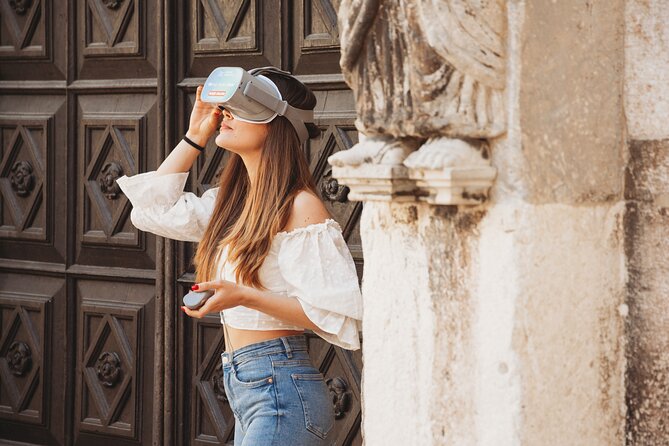
- VR headsets are included at every stop, not just for one highlight
- Small-group feel with a maximum of 25 people
- Short, focused timing: most sites are about 10 minutes each
- Closed interiors get a VR pass at multiple churches
- WWII and Crusader stories are built into the route, not tacked on
- You end at Sea Organ, a great place to keep exploring after the tour
How the Zadar VR walking tour works (and what to expect)

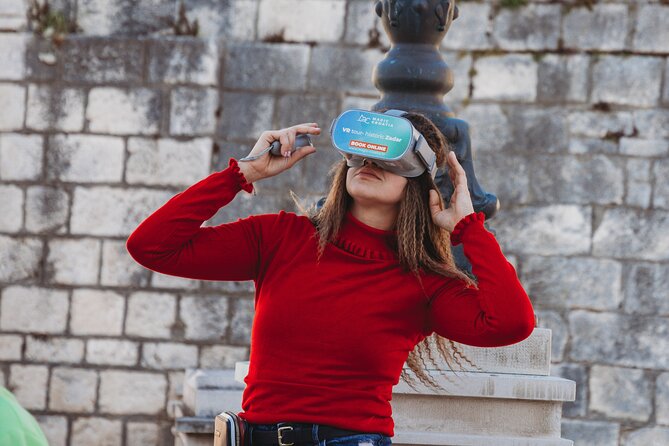
This is a guided walking tour of Zadar’s historic center, with VR scenes used to explain what you’re seeing in real life. You’re not stuck standing still. You move from one stop to the next, and the VR headset becomes a tool for context: showing interiors, placing you above buildings and ruins, or recreating events tied to Zadar’s past.
The pacing matters. At each location, you’re typically looking at the real site for a moment, then using VR for that site’s key “missing piece.” That means you’re always getting a reason for the walk, not just collecting landmarks.
Also, the tour is in English (and it notes that multiple languages are available). You’ll want to bring patience for the tech part: the experience can be very good when it matches the site well, and less impressive when it leans on older-style visuals. Still, the overall structure makes it easy to learn quickly.
You can also read our reviews of more tours and experiences in Zadar.

Church of St. Krševan: roman sandstone and a closed door
Your first stop is the Church of St. Krševan, also known by its connection to Chrysogonus. This Romanesque monastery church dates to 1175 and was built as the church of a male Benedictine monastery.
What I find smart here is that you start with a building that most visitors don’t get to see properly. The church is typically closed to the public, and that’s exactly where VR does its best work. Instead of only viewing an exterior you’ll see in passing, you get access—virtually—to areas such as the monastery courtyard and the interior.
On top of that, the outside is described as exceptionally well preserved for a Romanesque church. So even if VR is lower-tech at times, you still have real craftsmanship to look at: stonework, proportions, and the overall calm of the space.
St. Simon’s Church and the silver relic chest
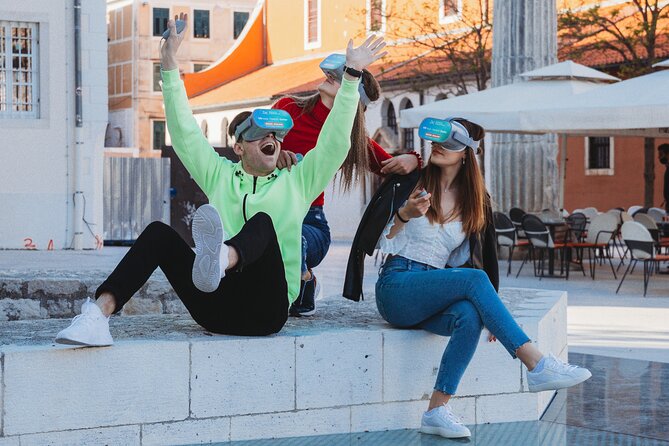
Next up is St. Simon’s Church, focused on the interior and Zadar’s religious heritage. The highlight here is the silver pleated Gothic chest that houses the relics of St. Simeon, who remains a favorite patron saint in the city.
This stop works best if you’re the type of traveler who enjoys small details you can’t easily “read” from the street. The tour guides you toward what matters inside, rather than treating the church as a quick photo stop. And because this is a guided experience, you’re not left guessing why a specific object or style detail is important.
One practical note: churches are often quieter than the surrounding streets, so bring a respectful volume. The tour timing is short, so being ready to move on helps you catch the full story without feeling rushed.
Five Wells: Roman gates, medieval entrances, and Venetian walls
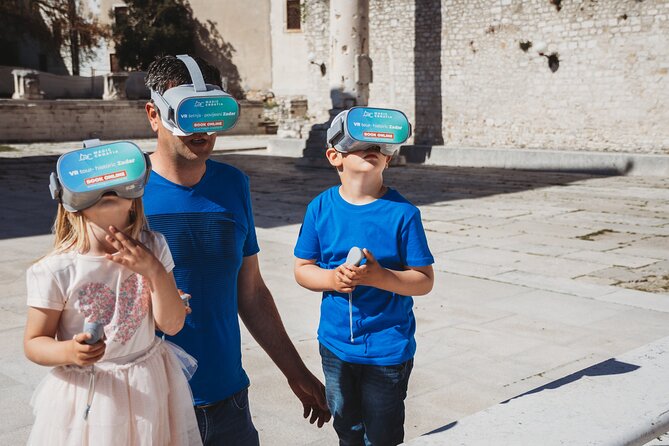
At Five Wells, you get a lesson in how Zadar expanded and reconfigured its defenses over centuries. The idea is simple but effective: you learn about the construction of the Roman gates that served as entrances into the antique city. Then you trace how later periods shaped (and replaced) those entry points, including the medieval city entrance and the later Venetian walls.
This is one of the stops where VR helps you “see the layout,” especially if the terrain feels flat or confusing when you’re standing in front of only partial remains. The tour ties the physical location to a timeline—Roman, medieval, Venetian—so you’re not just collecting ruins. You’re building a mental map.
If you’ve ever felt that Roman ruins are too fragmentary to understand, this is where the structure of the tour can pay off: it gives you interpretive help at the exact moment you need it.
The Roman Forum: VR from above, then you stand at the center
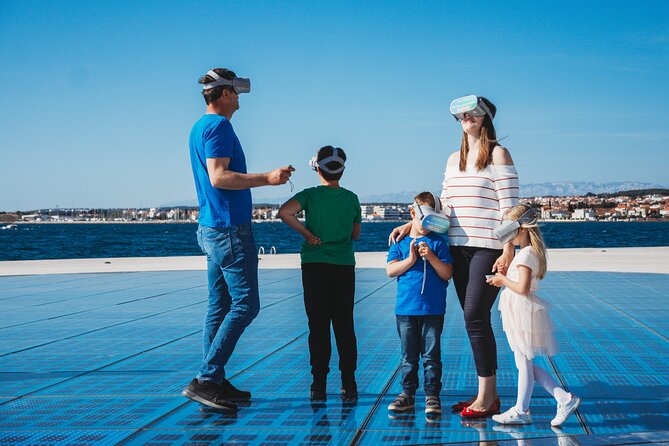
The Forum stop is the big one, and it’s handled in layers.
First, you see the remains of the Roman Forum inside Zadar’s old town. It’s described as the biggest forum built in Croatia, constructed from the 1st until the 3rd century, and today it’s visible mostly as ruins.
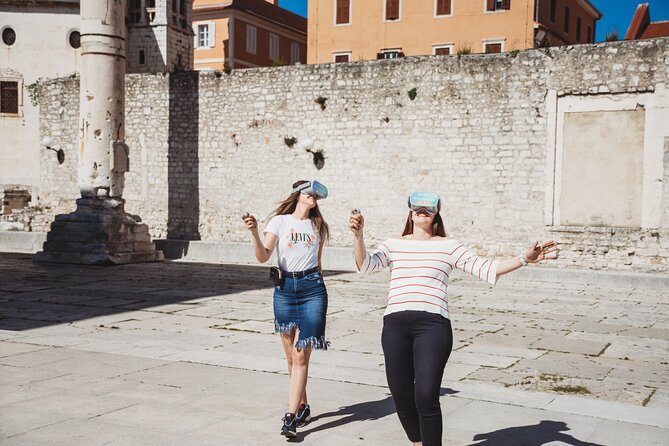
Then comes the VR sequence: you see the construction from an aerial perspective, like you’re in a hot-air balloon. An audio guide introduces facts as the visuals play. This is a key value of the tour format—ruins are hard to picture from ground level. VR turns “what you see now” into “what it looked like then,” which makes the real site easier to understand when you look again.
After the “from above” view, you take off the VR glasses and enter the Forum area. You stand in the very center, surrounded by recreated buildings and statues. The tour also takes you to a temple dedicated to Jupiter, Juno, and Minerva, dated to the 1st century BC, and you hear stories about ancient religious rituals.
The payoff is the moment the VR ends and reality catches you again. The tour’s framing emphasizes that some parts of the construction are still present in their original places after roughly 2,000 years. Even if you’re not a total history nerd, that’s the kind of detail that makes you look harder at what’s right in front of you.





St. Anastasia Cathedral: relics, plus rooms usually off-limits
The Cathedral of St. Anastasia is next, built in the 12th and 13th centuries and described as the largest cathedral in the Dalmatia region. St. Anastasia is one of Zadar’s city protectors, and her relics are housed inside the cathedral.
The tour’s VR value here isn’t about seeing a recreated “wow” scene. It’s about access. With VR glasses, you can visit parts that are generally closed to the public, including the baptistery and sacristy. You also hear the story of St. Anastasia, which gives the cathedral context beyond architecture.
This stop is a good choice if you want the route to include both Roman and medieval layers, and you like religion-as-art: relics, icons, and the way sacred spaces shape daily life. Even if the VR visuals aren’t perfect, the cathedral itself is a real, substantial experience that you can still appreciate on foot.
WWII and Zadar’s damage: Bell Tower visuals and the former city market
Two stops lean hard into the 20th century—Bell Tower and Paseo Maritimo—and they do it through VR scenes tied to Zadar’s bombing history.
Bell Tower (WWII simulation)
At the Bell Tower stop, VR recreates the WWII bombing, with you placed in the viewpoint of standing as if you’re up on the St. Anastasia bell tower. Buildings appear to burn and collapse due to airplanes dropping bombs. The scene ends with a map-style look at heavily damaged areas of the city that do not exist anymore.
This is emotionally heavier than the Roman ruins. If you prefer lighter sightseeing, you might want to mentally prepare for a stark chapter of history. The tour doesn’t shy away from it, and that directness is part of what makes the route memorable.
Paseo Maritimo (the market that vanished)
Then you move to the Paseo Maritimo, focusing on the location of the former city market. Here, the tour explains that people used to sell fish, vegetables, fruits, and other products. Today’s open city market is on the opposite side of town because the original market area was destroyed during WWII.
With VR, you see residential buildings and even a post office that no longer exists. You also witness aircraft dropping bombs over the city.
This pairing works well because it links history to everyday life. It’s not just “bombing happened.” You learn what disappeared from normal routines, including where people shopped and gathered.
Sea Organ: Greeting to the Sun in the 13th century, then back to today
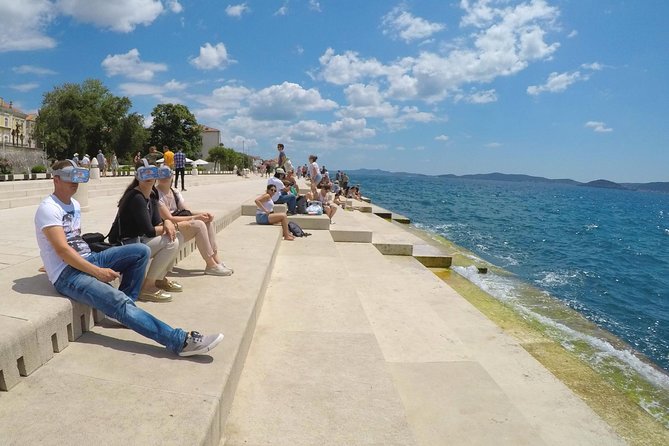
You end on the promenade at the Sea Organ, at Obala kralja Petra Krešimira IV. This is one of Zadar’s modern draws, built in 2005, and it’s tied to the sound-and-water idea of the Sea Organ and Greeting to the Sun.
The VR twist here is that you don’t only see the modern viewpoint. You see how the location looked in the 13th century—and you’re again positioned like you’re in a hot-air balloon. In the scene, you observe Crusaders attacking Zadar from the sea, and you hear the story of those attacks. The tour frames Zadar as a Catholic city during this conflict.
Even if the VR visuals are only “good enough,” ending here still makes sense. Sea Organ is a real place you can walk around after the tour. So you get the story during VR, then you get the physical reality at street level once you remove the headset.
Price and value: is $36.04 a good deal?
At $36.04 per person for about 2 hours, this tour sits in the “worth it if you like guided storytelling” zone. The value isn’t just the sites—it’s the combination of guided explanation plus VR access to spaces that are usually closed (like parts of St. Krševan and the baptistery/sacristy in St. Anastasia).
You’re also getting a route that spans a big time range: Roman forum days, medieval sacred spaces, and then WWII and Crusader scenes. That can be hard to assemble on your own without spending time bouncing between places and trying to figure out context.
Where the value could disappoint you is if you’re picky about VR quality. One downside is that some scenes can feel outdated or overly basic—like a panoramic view where you could see the same angle without VR. If you expect premium cinematic VR, adjust your expectations early and focus on the learning payoff.
Who this tour suits best (and who should skip it)
This guided VR walk is a great fit if you:
- like history you can visualize, not just read on a sign
- enjoy a structured route with short stops
- want VR access to interiors that are closed to most people
It’s also a nice option if you’re traveling with teens, since the VR component adds a change of pace from standard walking tours.
You might want to think twice if:
- you’re sensitive to disorientation (VR can feel strange when you’re looking down in a “no floor” perspective)
- you have high expectations for advanced VR effects
- you’re mainly seeking quiet, unstructured wandering
Should you book this Zadar guided tour with VR?
Book it if you want a fast, guided way to understand Zadar’s layers—Roman, medieval, sacred, and WWII—while getting VR access to places you’d otherwise miss. I’d especially recommend it if you learn best when someone helps you connect the dots in the moment.
Skip or treat VR as a bonus only if you’re the type who wants top-tier VR visuals. The route itself is strong—Roman Forum context, St. Anastasia’s cathedral, and ending at Sea Organ are all good reasons to go—even when the VR tech doesn’t fully wow.
FAQ
How long is the Zadar guided tour with virtual reality?
The tour lasts about 2 hours.
What does the tour cost?
It costs $36.04 per person.
Where does the tour start?
It starts at Magic Croatia – Travel Agency, Poljana Pape Aleksandra III 7, 23000 Zadar.
Where does the tour end?
It ends at the Sea Organ on the sea promenade (Obala kralja Petra Krešimira IV, 23000 Zadar).
What time does the tour begin?
The start time listed is 10:00 am.
Is the tour offered in English?
Yes, the tour is offered in English, and it notes that tours in multiple languages are available.
Are VR headsets included?
Yes. VR headsets are included as part of the experience.
Is there an entrance fee for the stops?
The tour description indicates admission tickets are free for the stops listed.
How big is the group?
The tour has a maximum of 25 travelers.
Are service animals allowed?
Yes, service animals are allowed.