REVIEW · SPLIT
Sightseeing Split’s Roman Ruins: A Self-Guided Audio Tour
Book on Viator →Operated by VoiceMap Audio Tours · Bookable on Viator
Split’s Roman ruins are still part of daily life.
This self-guided smartphone audio tour threads through Diocletian’s Palace, right in the middle of Split, using GPS so you can keep moving without stress. I like that you can start at your own time, and you get lifetime access so you can repeat the route when the light hits differently. I also really enjoy how the audio nudges you to notice details you’d miss if you were just wandering solo. One thing to consider: you’ll need to bring your own phone and plan to use your own headphones.
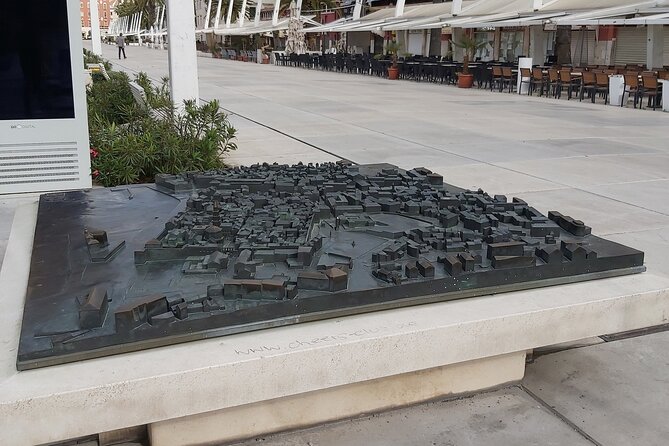
The route is built for clarity. You begin at the Model of the historical core of the city of Split, walk the Riva area, then work your way through the palace spaces and out toward the old-town streets and markets. I think the best part is the pacing: you can pause, look closely, and keep going when you feel ready. The main drawback is that the GPS at the start can be a little off sometimes, so I’d give yourself a minute to get oriented before you commit to the first audio segment.
If you want Roman history without joining a group, this format makes a lot of sense. You pay once, download the app, and then you’re free to explore Split at walking speed. It’s also a smart value for a short trip because you’re not paying for a guide’s time on top of your own curiosity—you’re buying a guided path you control.
In This Review
- Key things I’d plan for before you start
- Starting on the Riva at the city’s “front door”
- Walking into Diocletian’s Palace without the crowd pressure
- The cellars and Mozaik Podrum: where the palace feels layered
- Triclinium and the Museum: listen to the room names
- Peristyle and Vestibulum: pacing the big “palace breath”
- Jupiter’s Temple and the palace’s public face
- From palace gates to today: Silver Gate, Cathedral, and Golden Gate
- The statue, Synagogue, and old city hall: history beyond Roman walls
- Fish market and Fruit Square: ending where locals actually eat and wander
- Price and value: why $14.99 can make sense here
- How to get the most out of the audio (without turning into a statue)
- Who this tour suits best
- Should you book this Split Roman Ruins audio tour?
- FAQ
- What is the duration of the Split Roman Ruins self-guided audio tour?
- How much does the tour cost?
- Where does the tour start and end?
- Is the tour guided by a person?
- Do I need to pay for museum or other entrances along the route?
- What app does the tour use?
- Is the audio available offline?
- What do I need to bring?
- Is it refundable if I cancel?
Key things I’d plan for before you start
- Lifetime access to the English audio means you can redo it later without paying again
- VoiceMap with offline audio/maps/geodata is perfect when signal gets spotty in stone corridors
- GPS-based route helps you stay on track through Diocletian’s Palace and the old town
- Designed highlights in the palace take you through spaces like the cellars, Triclinium, and Peristyle
- Pass-by stops around town keep the walk feeling like real Split, not just a museum loop
- Bring a phone and headphones since they are not included in the price
Starting on the Riva at the city’s “front door”
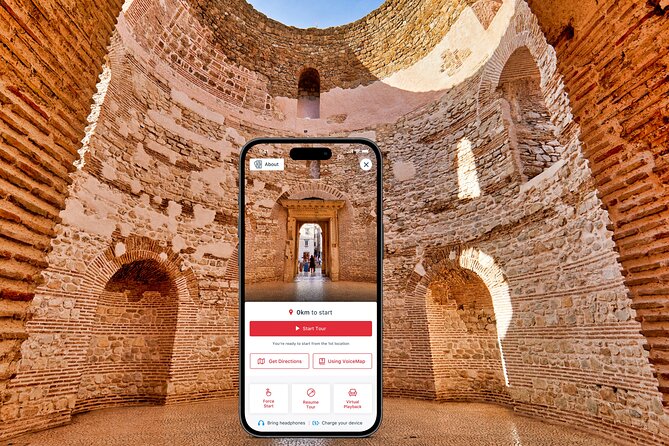
Your tour officially begins at the Model of the historical core of the city of Split, near Obala Hrvatskog narodnog preporoda 23. That’s a good choice because it puts you near the waterfront area locals actually use, not out in some disconnected parking lot. From there, you move toward the Riva, which sets the tone fast: sea air, working streets, and the sense that these Roman walls are still woven into the present.
When I’m choosing a self-guided walk, I care about one thing: will I feel lost? This one leans on GPS, so you should be able to follow along without constantly checking your bearings. Still, give yourself a minute at the first marker. One small hiccup can happen at the start, and then you can recover quickly if you just slow down and confirm you’re standing in the right spot before hitting play.
You can also read our reviews of more tours and experiences in Split.


Walking into Diocletian’s Palace without the crowd pressure

Soon you’re inside Diocletian’s Palace, the UNESCO-listed Roman palace complex that anchors Split’s historic center. The audio tour doesn’t just name places. It guides you to look where you are standing and helps you understand what you’re seeing in the context of palace life. That matters, because Diocletian’s Palace can feel like a maze at first—beautiful, yes, but easy to wander through without a mental map.
This is where the self-led format really pays off. Guided tours can be great, but they also demand your attention at the exact pace of the group. Here, you control the rhythm. If you want to linger on a doorway, step into a shade pocket, or take a couple photos, you can. If you’re someone who likes to move quickly, you can keep the walk flowing. Either way, the audio is there to connect the dots.
The cellars and Mozaik Podrum: where the palace feels layered
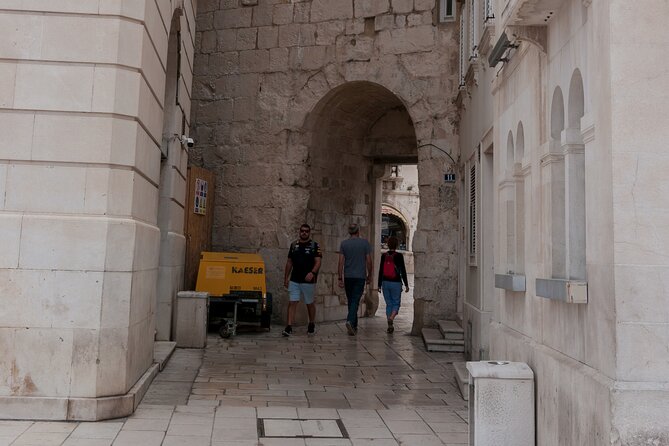
A highlight part of the route is a brief stop in the cellars, followed by passing the Mozaik Podrum. Even without a ticketed museum stop, these are the kinds of spaces that change how you picture the palace. Upper levels get all the attention. Cellars and under-areas remind you that this was a full functioning complex, not just a sightseeing backdrop.
Expect the tour to guide your attention to the built environment around you—stonework, transitions, and the way the palace layout creates different atmospheres in different corners. The audio helps you make sense of why a lower space isn’t just “a hallway,” but part of the palace’s internal logic.
One practical tip: cellars and indoor-adjacent areas can feel cooler and slightly dimmer. That’s not a problem, just plan for slower phone-screen reading if you’re relying on the map interface. The audio is the key anyway, and it’s available offline once downloaded.
Triclinium and the Museum: listen to the room names
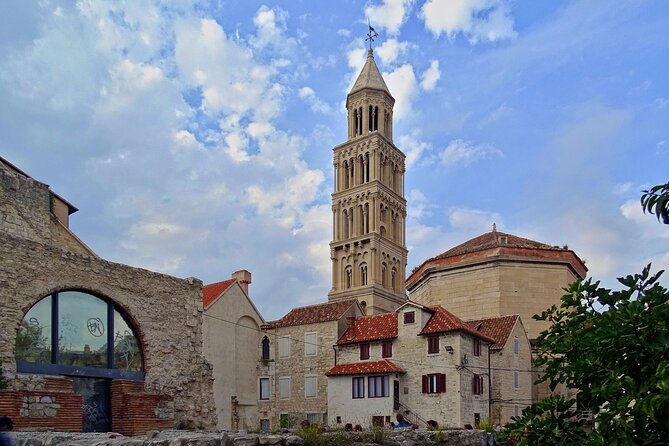
Next up is the Triclinium, followed by the Museum. The Triclinium label matters because it’s the kind of word you’d glance past if you didn’t know what to connect it to. The audio tour uses these named points to help you translate Roman terminology into what you’re looking at on the ground.
After that, you pass a Museum stop. Importantly, the tour price does not include museum tickets or entrance fees. So you’re not paying for entry—you’re using the route to understand what the site is and why it’s worth noticing as you walk by. If you want to go inside later, you’ll need to handle any tickets separately.
I like this approach because it keeps the walking experience moving. You don’t get trapped in a time slot or delayed by lines. You can stay focused on the outdoor ruins and the architecture that’s on display right where you’re standing.
Peristyle and Vestibulum: pacing the big “palace breath”
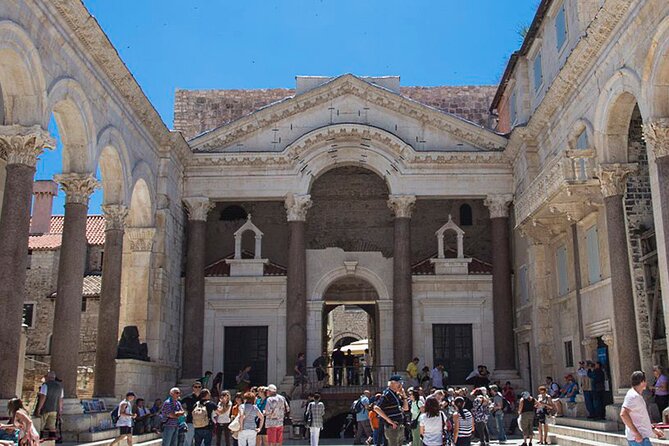
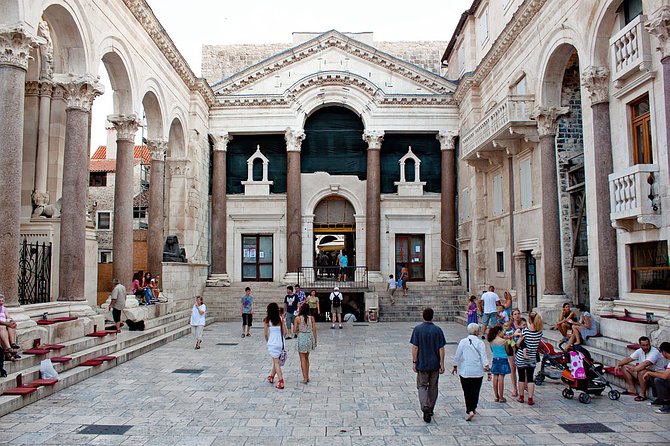
Then the route takes a brief stop at the Peristyle and a brief stop at the Vestibulum. These are exactly the kinds of spaces that change the feel of your walk. A courtyard-like area like a peristyle usually gives you more space, more sightlines, and a clearer sense of scale. An entry hall space like a vestibulum helps you understand how people moved between outer streets and inner areas.
This is also a good point in the tour to slow down and let your eyes do what your brain is trying to learn. If you’re new to Roman architecture, this middle stretch helps your mental map start clicking. You’ll feel less like you’re roaming and more like you’re following a route inside a real building complex.




Jupiter’s Temple and the palace’s public face
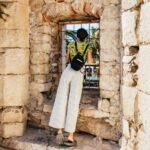
The audio then stops briefly at Jupiter’s Temple. Even if you don’t know a lot of Roman religious history going in, the tour structure gives you a chance to anchor that name to the place itself. These kinds of stops are useful because they break the walk into meaningful units instead of a nonstop stream of streets and stones.
I also like that the audio doesn’t force you to treat Split’s palace as a sealed-off past. You’re still walking with the city around you, and that makes the Roman layers feel like part of everyday space, not something you only visit with a ticket.
From palace gates to today: Silver Gate, Cathedral, and Golden Gate
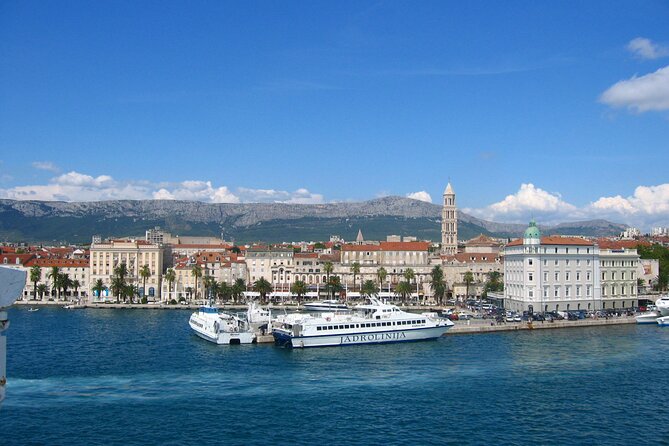
After the temple stop, the tour passes major connectors: Palaca Cindro, the Silver Gate, the Cathedral, the Split City Museum, and the Golden Gate.
This is a smart sequence because it helps you read the palace boundaries and the transitions outward. You’ll learn to recognize gates not as random entry points, but as how a big complex organizes movement. Even if you don’t go into every building, you’ll get a better sense of where you are within the old structure.
The Cathedral and Split City Museum are especially important in the context of Split’s story because the palace complex didn’t just sit there unchanged. It became a living part of the city fabric. You’ll get an audio-based introduction just by passing, and that’s often enough to decide whether you want deeper ticketed time later.
The statue, Synagogue, and old city hall: history beyond Roman walls
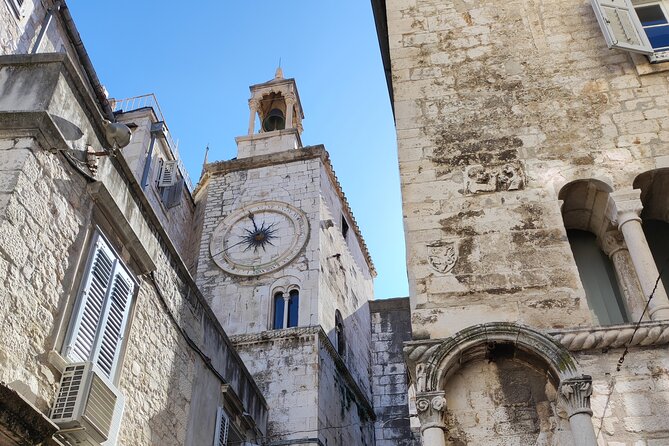
The tour keeps going past a statue, the Synagogue, the old city hall, and Standarac, then toward a Chapel. This is one reason I think the audio route works well for first-timers: it doesn’t treat Diocletian’s Palace as the only story you should care about.
As you pass these sites, the audio helps you connect them to the wider historic town feel. Names like Synagogue and old city hall broaden the walk from purely Roman context into the layered identity of Split. You’re not only learning what Romans built—you’re learning how later communities shaped the same streets.
Practical note: parts of the route are in dense old-town areas, so phone screens can be tough in bright sun and crowds. Use the audio as your main guide, and let the map function be a backup.
Fish market and Fruit Square: ending where locals actually eat and wander
You’ll pass the fish market and then move through the square before ending at Fruit Square (Radić Brothers Square) in the Trg Braće Radić 5 area. This finish point is ideal because it gives you an immediate payoff: you finish the ruins portion and step right into a lively central zone where you can keep exploring or grab a bite nearby.
If you’re thinking about timing, this ending helps. You don’t get left at some distant stop. You finish in a place that’s walkable for whatever comes next—another street loop, a longer waterfront stroll, or just sitting down with something local.
Price and value: why $14.99 can make sense here
At $14.99 per person, the value comes from the combination of format and access. You’re not paying for a guided group experience; you’re paying for a route you can replay. The big win is lifetime access plus offline access to audio, maps, and geodata. That turns this from a one-time ticket into a tool.
A self-guided palace walk can save money if you’d otherwise book a guided tour, especially for a compact route that fits into an hour or a bit more (about 1 hour to 1 hour 15 minutes). And because it’s self-led, you avoid the common “stopped for the group, rushed for the photos” problem.
The one cost you need to plan for is your own gear. Your smartphone and headphones are not included, so make sure you’ve got them charged before you head out.
How to get the most out of the audio (without turning into a statue)
This kind of tour is at its best when you treat the audio as a companion, not a command. I like to pause once or twice during the palace section, just to match what the audio is telling me with the building in front of me. The audio points out named areas like Triclinium, Peristyle, Vestibulum, and Jupiter’s Temple—your job is simply to look.
A few habits that make the experience smoother:
- Download before you leave so you can rely on offline audio/maps.
- Keep your phone brightness moderate in sunlight so the map stays readable.
- If GPS seems off at the start, don’t panic. Slow down, line up with the landmark, and press play again once you’re sure you’re in the right place.
- Bring a small patience buffer. Even with GPS, old streets mean you sometimes walk a slightly different line than the map expects.
Who this tour suits best
This is the right fit if you:
- Want Roman and old-town context but don’t want to commit to a guided group pace
- Like walking for an hour or a little more without a long schedule
- Prefer flexibility—start when you feel ready, not when a tour meets
- Travel with your own pace and want to stop for photos or quiet moments
It’s also great if you’re doing Split in a tight itinerary and want something that adds meaning to the ruins you’ll see anyway. You get a guided framework while still feeling like you’re exploring your own way.
Should you book this Split Roman Ruins audio tour?
I’d book it if you want a clear way to enjoy Diocletian’s Palace and the surrounding old town without the pressure of a group. Lifetime access, offline audio/maps, and a route that ties together named spaces like Triclinium, Peristyle, and Jupiter’s Temple make it a solid value for the money.
Skip it (or at least think twice) if you’re hoping for a traditional guided narration in a live voice, or if you don’t want to deal with a smartphone-based experience. Also, if you’re the type who needs signage and in-person help at every turn, the self-guided format might feel too hands-on.
If you’re comfortable using your phone as a guide and you want to explore Split on your schedule, this is a smart, practical way to turn stone walls into a story you can actually follow.
FAQ
What is the duration of the Split Roman Ruins self-guided audio tour?
It takes about 1 hour to 1 hour 15 minutes.
How much does the tour cost?
The price is $14.99 per person.
Where does the tour start and end?
It starts at the Model of the historical core of the city of Split near Obala Hrvatskog narodnog preporoda 23, and it ends at Radić Brothers Square (Fruit Square), Trg Braće Radić 5.
Is the tour guided by a person?
No. It’s a self-led smartphone audio walking tour.
Do I need to pay for museum or other entrances along the route?
Tickets or entrance fees are not included. You’ll need to pay separately if you want to enter museums or attractions.
What app does the tour use?
It uses the VoiceMap app for Android and iOS.
Is the audio available offline?
Yes. You get offline access to audio, maps, and geodata.
What do I need to bring?
You need a smartphone and headphones. Transportation and food/drink are also not included.
Is it refundable if I cancel?
No. This experience is non-refundable and cannot be changed for any reason.