REVIEW · TROGIR
Trogir walking tour with a local guide
Book on Viator →Operated by Discovery tours · Bookable on Viator
Trogir feels compact, but it packs real drama. This local-guided walking tour strings together the town’s biggest landmarks—cathedral art, Venetian-style buildings, and sea views—without wasting time. I especially love how the guide connects dates and styles to what you can actually see in front of you.
I also like the small-group pace. With a maximum of 15 people, stops feel relaxed enough to ask questions and actually look closely, whether you’re focusing on Radovan’s stonework or the waterfront’s Čiovo views.
One consideration: the walk is short, so you need to be ready for a brisk tour rhythm, and timing can run closer to about an hour than the full 1 hour 30 minutes for some groups. On hot days, pace + pavement can feel like a workout, too.
In This Review
- Key highlights you’ll want on your Trogir checklist
- Trogir’s Old Town in about 90 minutes: what you’ll actually see
- St. Lawrence Cathedral and Radovan’s Portal: medieval art and big views
- John Paul II Square and the Town Hall staircase: Venetian architecture in everyday life
- St. Sebastian church, clock tower, and the Town Loggia: how public life worked
- Palace Cipiko and Niccolò di Giovanni Fiorentino’s fingerprints
- Garagnin-Fonfogna palaces, Our Lady of Mount Carmel, and the Kairos bas-relief
- Riva promenade and Kamerlengo Castle: best sea views, no detours
- Price and logistics: is $18.14 worth it?
- Who this tour suits (and who may want a different pace)
- Should you book this Trogir walking tour with a local guide?
- FAQ
- How long is the Trogir walking tour?
- What language is the tour offered in?
- What is the price per person?
- How big is the group?
- Is it a mobile ticket or do I need a printed one?
- Where does the tour start and end?
- Do I need to pay admission at the stops?
- What happens if the weather is bad?
- Is the tour suitable for most people?
- Is it refundable if I cancel?
Key highlights you’ll want on your Trogir checklist
- St. Lawrence Cathedral’s bell tower panoramas over Trogir, Čiovo, the Adriatic, and the mainland
- Radovan’s Portal, a standout 13th-century sculpture at the cathedral entrance
- Venetian-flavored architecture around John Paul II Square, Town Hall, and the outdoor staircase
- Clock tower + St. Sebastian story tied to gratitude after the plague
- Palace Cipiko and Niccolò di Giovanni Fiorentino’s work, including the south portal
- Riva waterfront to Kamerlengo Castle, for a straight shot of sea views
Trogir’s Old Town in about 90 minutes: what you’ll actually see
This tour is built for your first time in Trogir. At roughly 1 hour 30 minutes, it hits the core sights in a logical loop: start with the cathedral and gates-side landmarks, then move into the Old Town streets and civic buildings, and finish along the waterfront promenade toward Kamerlengo Castle.
The structure matters for value. You’re paying for a guide’s ability to explain what you’re looking at—why one building looks Romanesque but also Gothic, why a clock tower sits where it does, and why certain spaces were used for public life. Without that context, some of these stones can blur together. With it, Trogir becomes easier to navigate and far more memorable.
You’ll also get small-group energy. I’ve seen guides like Daniela, Kristina, and Blanca highlighted for making the town feel personal and easy to follow—calm explanations, clear sequencing, and lots of time to look at details.
You can also read our reviews of more tours and experiences in Trogir.

St. Lawrence Cathedral and Radovan’s Portal: medieval art and big views
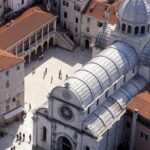
You start with the Cathedral of St. Lawrence, whose story is as long as it is impressive. Construction began in 1213 and continued for five centuries—so when you look up, you’ll notice a mix of Romanesque and Gothic elements rather than one uniform style.
Inside, the scale is part of the point: the cathedral has three naves. The guide’s job here is to help you “read” the building—understanding that the design evolved over time, even though it still feels like one statement.
Then you get the payoff: the bell tower. It’s the place for panoramic views over:
- Trogir
- the island of Čiovo
- the mainland
- and the Adriatic Sea
It’s the kind of view that turns a small town into a map you can understand.
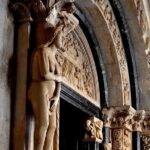
The other must-see is Radovan’s Portal, the cathedral’s main entrance. Master Radovan, a medieval craftsman from Trogir, sculpted and carved this work in the first half of the 13th century. This is one of those details you’ll miss if you’re speed-walking through photos. Take a moment at eye level and let the guide point out what makes it special—stone carving like this is how a medieval town showed off pride, faith, and skill.
Practical note: if you’re sensitive to stairs, plan for a short climb tied to the bell tower viewpoint.
John Paul II Square and the Town Hall staircase: Venetian architecture in everyday life
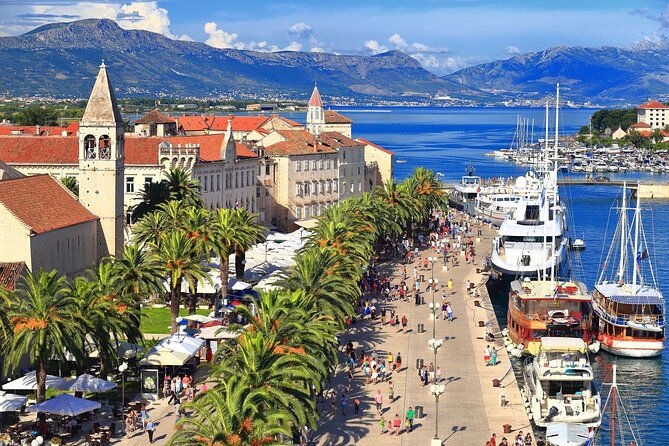
After the cathedral, you step into the civic heart: John Paul II Square (Trg Ivana Pavla II). This piazza has a laid-back energy that doesn’t feel staged. You’ll be surrounded by major historic buildings, but the real rhythm comes from locals and their café tables and umbrellas. It’s basically a historic outdoor living room.
The practical way to enjoy it: let the guide explain what you’re looking at, then take 5 minutes to sit. Even if you don’t order anything, the pause helps your brain connect the landmarks into a real neighborhood.
Next comes the Town Hall, built in the 15th century. What stands out is the stone building and its courtyard, decorated with coats of arms. But the star here is the outside staircase. It’s one of the most striking examples of Venetian architecture in Trogir, and it’s the kind of feature you understand better when someone points out its design logic.
If you’re photographing, this is a good moment to slow down. Staircases and courtyards create strong angles, and a local guide can often tell you where the best viewpoints are based on how the square sits.
St. Sebastian church, clock tower, and the Town Loggia: how public life worked
From the square area, the tour shifts to the cluster of buildings tied to community identity—especially the stories that explain why these monuments exist.
You’ll visit St. Sebastian’s Church and Clock Tower. The church was built in 1476 by Trogir’s citizens as thanks for being delivered from the plague. That single detail changes how you see the façade. This isn’t just decorative architecture; it’s a public memory made of stone.
The architect was Niccolò di Giovanni Fiorentino (also known as Nicolas of Florence). Expect the guide to connect the design choices to that broader Mediterranean artistic world, not as trivia, but as context for why certain shapes and elements repeat across the region.
Then you move to the Town Loggia, dating back to the 13th century. This is a covered space next to the clock tower—used for citizen gatherings to discuss issues of the day. The local court would meet here on certain days to proclaim laws and handle cases.
This is one of my favorite parts of the tour because it makes the town feel functional. You can stand in a loggia and imagine the daily flow of decisions: people coming together, hearing announcements, and dealing with real life. If you like architecture that comes with human context, this stop won’t feel dry.
Palace Cipiko and Niccolò di Giovanni Fiorentino’s fingerprints

Next up is Palace Cipiko—a group of Romanesque buildings that later took on a Venetian Renaissance look between the 15th and 17th centuries after extensive remodeling.
The guide’s explanation is key here. Without it, it’s easy to view it as a “big old palace.” With it, you’ll understand why the style seems layered: Trogir’s wealth and connections changed over time, and the architecture followed.
Niccolò di Giovanni Fiorentino is again part of the story. He worked on this project and carved the south portal. That portal is worth paying attention to because it’s where the details look most intentional—like you’re catching the work of a specific artist rather than a vague period style.
If you’re thinking, Okay, but what do I do with all this? Here’s the simple answer: watch for how the guide ties each building back to a theme—trade, civic pride, artistic influence, and how Trogir balanced different eras.



Garagnin-Fonfogna palaces, Our Lady of Mount Carmel, and the Kairos bas-relief

Trogir Old Town doesn’t just open with a gate—it opens with history you can walk into.
As you enter through the North Gate, you’ll be in a zone tied to palaces once owned by the Venetian Garagnin-Fonfogna family. The museum sits in these palaces, and even if you don’t go inside, stepping into the palatial space helps you understand how the town’s old power structures worked.
Then you head toward the waterfront side to find Church of Our Lady of Mount Carmel. This church was founded in the Middle Ages and historically served Trogir’s fishermen, craftsmen, and laborers. It’s easy to miss this kind of “working community” landmark when you’re only hunting for the biggest tourist wow-factors, so I appreciate that the tour includes it.
And there’s a real date-based reason to remember it: if you’re in Trogir on 16 July, the church offers a traditional evening procession with the statue of Our Lady. Even if you’re not there in July, knowing that the church is tied to community practice—not just architecture—adds weight to the visit.
One more stop in this stretch is a bas-relief tied to the concept of Kairos (the right moment). The scene shows a young man tiptoeing, arms out, scales in hand, with a tuft of hair over his forehead and a bald crown. The idea is basically: the moment won’t wait—seize it or it will fly away on wings, leaving you empty-handed.
This is a surprisingly fun detour for a walking tour because it turns a visual detail into a story you can remember on your way back to the hotel. It’s not history in the textbook sense; it’s history as symbolism.
Riva promenade and Kamerlengo Castle: best sea views, no detours
After you’ve absorbed the Old Town monuments, the tour gives you a breath of air on the water.
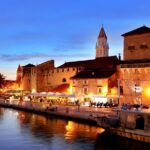
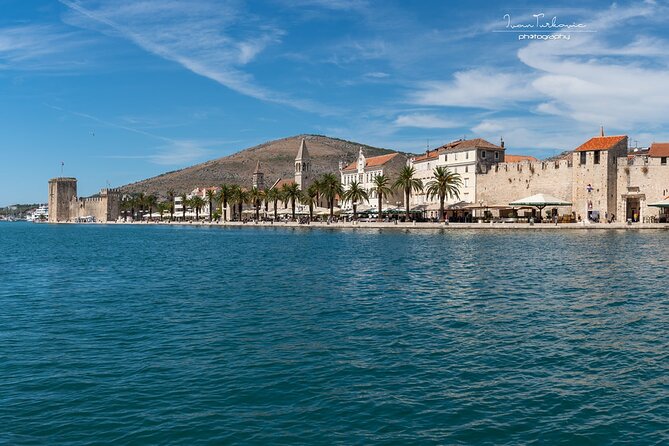
You’ll walk along Riva, what locals call Trogir’s promenade. It’s wide, flat, and straight, running along the water edge. The views are the point: you’ll look across the sea channel to Čiovo, and the whole promenade works like a moving viewpoint.
This is a good moment to check your energy and take photos without craning your neck nonstop. Because the promenade is flat and linear, it’s also easier to keep your bearings for the rest of your stay.
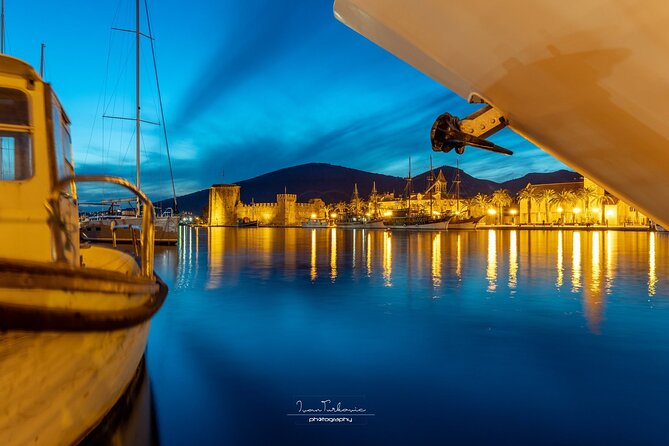
At the end of the promenade sits Kamerlengo Castle, an early 15th-century fortress at the tip of the Old Town’s little island. It’s positioned on the corner for strategic views—both over the channel and toward the town behind you.
Right next to it, you’ll also see a local football pitch, a small playground for kids, and stalls connected to tour operators. It’s not just a quiet ruin. It’s a living edge of town where visitors and locals overlap.
Price and logistics: is $18.14 worth it?

At $18.14 per person, this is priced like a budget-friendly “get your bearings fast” tour. For me, the value comes from three things you can’t easily DIY:
First, the guide’s ability to connect what you see—especially cathedral art, civic buildings, and the repeated role of Niccolò di Giovanni Fiorentino. Second, the sequencing. Trogir’s Old Town is a maze, and the tour’s loop helps you avoid wandering in circles. Third, the small-group limit of 15 people, which keeps the tour from feeling like a stampede.
The sites you stop at are listed as admission ticket free for the specific segments noted on the tour description. That doesn’t mean everything is free everywhere, but it does keep the tour experience straightforward and predictable.
Timing is the one “fine print” style issue you should watch. Even though the tour runs about 1 hour 30 minutes, at least one group reportedly finished in about 60 minutes. If you’re trying to chain this tightly with another timed plan, build in buffer.
Who this tour suits (and who may want a different pace)
This tour is a great fit if:
- You want a short first pass through Trogir
- You enjoy stories tied to buildings, like the plague origin of St. Sebastian
- You like architecture with specific creators named, like Niccolò di Giovanni Fiorentino and Master Radovan
- You want sea views without planning a separate route
You might choose differently if:
- You’re looking for a long, slow wander with lots of free time in each spot
- You dislike heat walking (the tour is outdoors and can get warm)
- You’re the type who needs a full, leisurely museum visit rather than quick landmark stops
Based on the guide names people rave about—Daniela, Kristina, Blanca, Michaela, Michael, and Christina—this is also a strong choice if you like personal storytelling from a local perspective.
Should you book this Trogir walking tour with a local guide?
I’d book it if you want the smart move in a limited time window. For the price, you get a guided path through Trogir’s most important visual anchors: St. Lawrence Cathedral (with the bell tower views and Radovan’s Portal), Venetian-style civic landmarks, and the waterfront walk that ends at Kamerlengo Castle.
My final advice is simple: wear comfortable shoes, bring water in warmer months, and give yourself slack for timing. If you do that, you’ll leave with a map in your head—plus a set of details you can point to when you wander back through the Old Town later on your own.
FAQ
How long is the Trogir walking tour?
It’s about 1 hour 30 minutes.
What language is the tour offered in?
It’s offered in English.
What is the price per person?
The price is $18.14 per person.
How big is the group?
The maximum group size is 15 travelers.
Is it a mobile ticket or do I need a printed one?
It uses a mobile ticket.
Where does the tour start and end?
Start: Ul. Gradska vrata 5, 21220, Trogir. End: Obala bana Berislavića, 21218, Trogir.
Do I need to pay admission at the stops?
The tour description notes admission ticket free for the listed stops.
What happens if the weather is bad?
The experience requires good weather. If it’s canceled due to poor weather, you’ll be offered a different date or a full refund.
Is the tour suitable for most people?
Most travelers can participate.
Is it refundable if I cancel?
This experience is non-refundable and cannot be changed for any reason.