REVIEW · SPLIT
Walking Tour of Split and Diocletian’s Palace
Book on Viator →Operated by Ancient Tours · Bookable on Viator
You can feel Roman Split under your feet. This small-group walk threads you through Diocletian’s Palace and Split’s historic center, with an English-speaking guide and a tight route that keeps the big sites from feeling overwhelming.
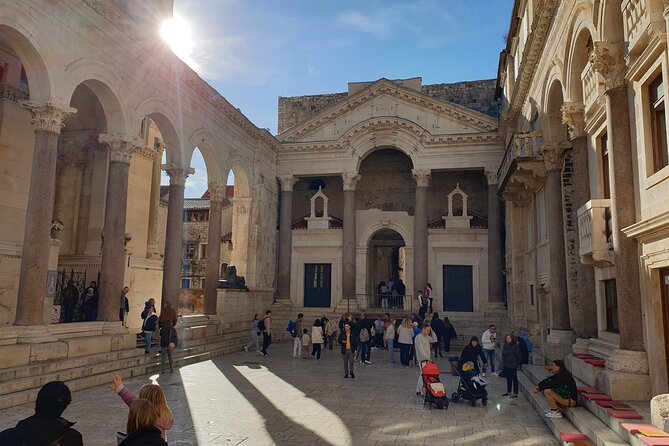
I love how you start at the Peristyle, the palace’s central square, so you quickly understand where you are and what you’re seeing next. I also like the Golden Gate stop, with stories tied to Gregory of Nin and even the language around his legacy.
One real consideration: in busy palace areas, it can be hard to hear the guide if you’re not standing close and there aren’t earbuds or headsets.
In This Review
- Key things to look forward to
- Why Diocletian’s Palace Is the Smart First Walk in Split
- Price and what you really get for $48.37
- Meeting Point: Peristil ul. and the easiest way to start on time
- Stop 1: The Peristyle of Diocletian’s Palace (the palace square that makes everything make sense)
- Stop 2: Vestibulum of Diocletian’s Palace (stories, and a possible Dalmatian song)
- Stop 3: Diocletian Palace Substructures (structure first, museum later)
- Stop 4: Golden Gate and the Gregory of Nin connection
- Stop 5: Riva Harbor and that bronze palace model
- Stop 6: Fruit’s Square (Trg Brace Radic) and Marko Marulić’s legacy
- Stop 7: Split Synagogue pass-by (what to expect if you’re curious)
- Group size, hearing the guide, and handling crowds inside the palace
- How to get the most out of a 90-minute orientation tour
- Value check: should you spend $48.37 on a guided walk instead of free roaming?
- Should you book this Diocletian’s Palace walking tour?
- FAQ
- How long is the Walking Tour of Split and Diocletian’s Palace?
- Where does the tour meet, and where does it end?
- Is the tour offered in English?
- Are admission tickets included in the tour price?
- Will we visit the museum part of the Diocletian Palace substructures?
- Is the Split Synagogue included as an entry stop?
- How big is the group?
- Is the tour suitable for people who have trouble with steps?
- Can I cancel for a full refund?
Key things to look forward to
- UNESCO setting first: You get your bearings in Diocletian’s Palace right away.
- Small group feel: Maximum 20 travelers means less crowd pressure than the mega tours.
- Guide-led storytelling: Feedback names guides like Mario, Antonela, Antonio, Leo, and Professor Marino for clear English and engaging delivery.
- You skip the paid museum part: The substructures stop focuses on the structure and history, without touring the museum section.
- Split’s highlights beyond the palace: You also reach Riva Harbor and Fruit’s Square.
Why Diocletian’s Palace Is the Smart First Walk in Split

Split’s old town can feel like a maze at first: stone everywhere, narrow lanes, and the big Roman structures hidden inside daily life. This tour gives you a map made out of stories. Instead of wandering randomly, you walk the palace core, learn what each space was built for, and then connect the dots to the rest of Split’s historic center.
The other reason I’d book this early is simple: once you understand the palace layout, everything else clicks. You’ll start noticing how medieval and later life layered itself on top of Roman planning. And because it’s English, you can focus on the places instead of trying to decode signage.
You can also read our reviews of more tours and experiences in Split.


Price and what you really get for $48.37
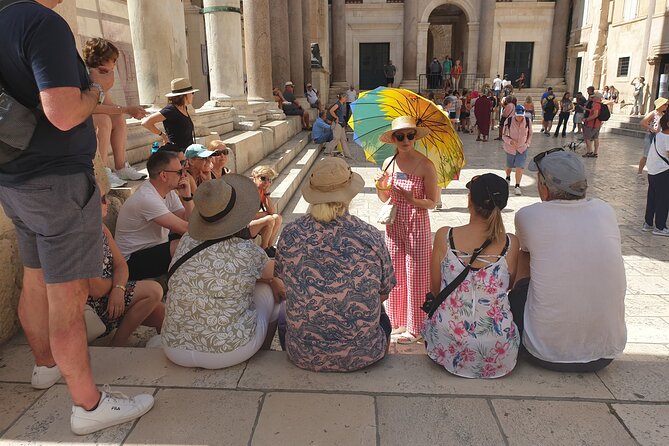
At $48.37 per person for about 1 hour 30 minutes, you’re paying for guide time, route design, and interpretation. You’re not paying for paid entrances as part of the ticket. The tour keeps the core palace experience free in many stops, while the few sections that require admissions are not bundled.
Is it worth it? In my view, yes if you want a fast, high-impact orientation. For Roman sites, the difference between reading a sign and hearing context is huge. And with a maximum of 20 people, you’re more likely to ask questions and keep up at normal walking speed.
If you’re the type who loves to self-tour, you can still do that. But if your time in Split is short, a structured route is the easiest way to avoid missing the key spaces.
Meeting Point: Peristil ul. and the easiest way to start on time
The meeting point is Peristil ul., 21000, Split, Croatia, and the tour ends back at the same spot. That loop is nice because you don’t end your walk stranded somewhere else.
That said, some feedback flags that the starting point can be tricky to locate. My practical advice: arrive a few minutes early and do a quick visual check for your group. Also, keep your phone ready for messages, just in case schedules shift on the day.
You’ll also be close to public transportation, so if you’re coming from a port or bus stop, you won’t need a long taxi ride just to begin the tour.
Stop 1: The Peristyle of Diocletian’s Palace (the palace square that makes everything make sense)

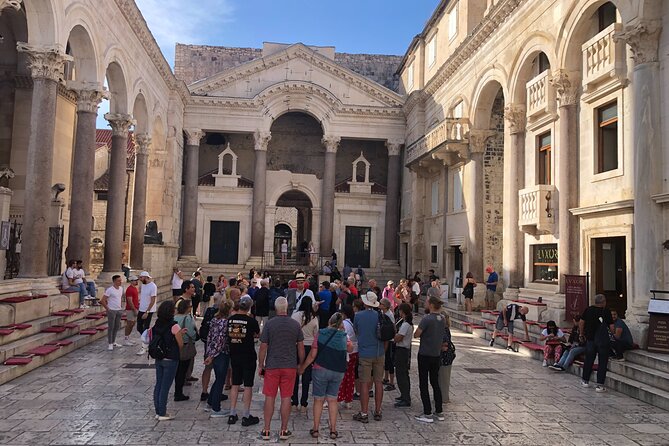
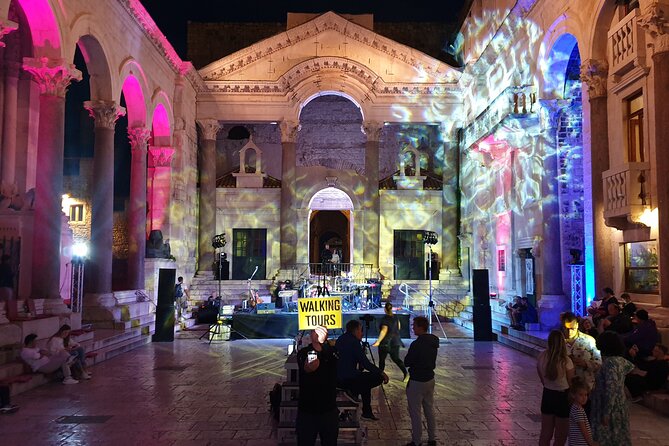
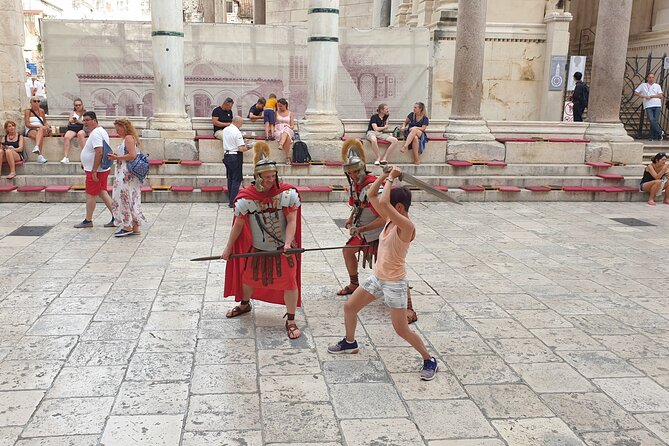
Your first stop is the Peristyle, the palace’s central square. This is the right way to begin because it acts like the palace’s “hub.” From here, you can understand how many of the other palace locations connect.
In practical terms, learning the Peristyle early helps you stop feeling lost. Once you grasp this center point, later stops won’t just look like random arches and corridors. They’ll feel like a system. And the setting is unforgettable: Roman stone, palace-scale openness, and the sense that Split’s modern streets grew around an older plan.
This stop is about 15 minutes and doesn’t require an admission ticket.
Stop 2: Vestibulum of Diocletian’s Palace (stories, and a possible Dalmatian song)
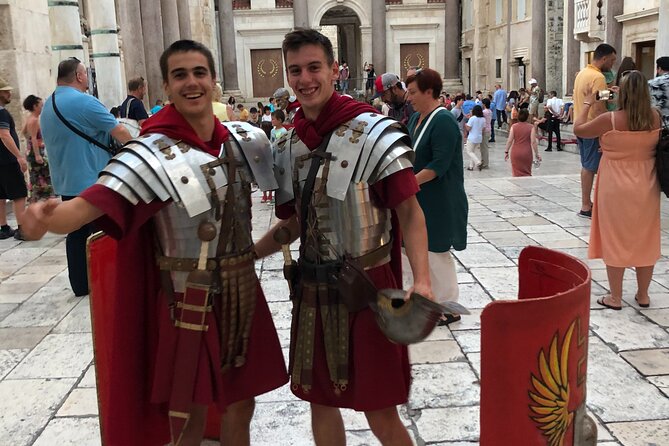
Next you’ll head to the Vestibulum of Diocletian’s Palace. This is where the guide focuses on the emperor’s context and what you’re looking at structurally and historically.
One fun detail included in the tour description: you might hear traditional Dalmatian singing. That’s not something you can guarantee, but it’s a lovely way to add sound to the stone—very “Split,” not just “Roman ruins.”
This stop is shorter, around 5 minutes, and it’s designed as a quick story stop rather than a long break. No admission ticket is needed here.




Stop 3: Diocletian Palace Substructures (structure first, museum later)
Now comes the under-layer: the palace substructures. This area is where you learn how parts of the palace were built and what roles they played through different periods.
Important for planning: the tour notes that you won’t visit the museum part of the substructures. That means you get the core walkthrough and interpretation on this tour, but you can choose to return later if you want more. Admission isn’t included for the museum sections (and the museum isn’t part of your guided route here), so don’t assume this ticket covers everything inside.
Plan for about 10 minutes at this stop. It’s a focused segment, not a long indoor experience, so it fits well into the 90-minute format.
Stop 4: Golden Gate and the Gregory of Nin connection
At the Golden Gate, you’ll see a major entrance of the palace and hear how its role fits into the wider story of Split. This stop also brings in a key local figure: the statue of Gregory of Nin.
Why this matters: the tour doesn’t treat Gregory as just a name on a statue. You’ll learn his importance to local history and even the story behind language. That’s the kind of detail that makes a city tour feel personal. It explains why something is important to the culture around you, not only to ancient Rome.
This stop is about 10 minutes and doesn’t require an admission ticket.
Stop 5: Riva Harbor and that bronze palace model
After the palace core, you step out toward Riva Harbor. Here you’ll spot a bronze model of Diocletian’s Palace and use it like a cheat sheet: the guide helps translate the palace you just walked into a scale model you can visualize.
Then you’ll connect it to the way Split’s Riva promenade became part of the city’s daily life. Riva is where visitors take photos and locals take walks—so hearing how it relates to the palace gives you a fuller picture of why the waterfront matters.
This stop is around 15 minutes, and it’s free of admission fees.
Stop 6: Fruit’s Square (Trg Brace Radic) and Marko Marulić’s legacy
Back inland, you’ll reach Fruit’s Square (Trg Brace Radic). This is a great pause in the route because it’s a public space where the stories stop being only about architecture and start being about culture.
You’ll learn about a 15th-century Venetian citadel tied to this area. Then the guide brings in Marko Marulić, described as the father of Croatian literature. That’s a bigger deal than it sounds, because it shows how Split isn’t just Roman. It’s Venetian, Croatian, Jewish, and more—layered across centuries.
This stop is about 10 minutes and doesn’t require admission.
Stop 7: Split Synagogue pass-by (what to expect if you’re curious)
Your final stop is a pass-by of the Split Synagogue, a site tied to the 16th-century history of the Jewish community in Split. This is not presented as an entrance-and-tour stop in the tour description, so admission isn’t included.
Plan for about 10 minutes here. The value is in context: it broadens your understanding of Split as a real city with multiple communities, not just a single-era monument.
If you want to go inside, you’d likely need to handle that separately, since the tour does not include synagogue admission.
Group size, hearing the guide, and handling crowds inside the palace
This tour caps at 20 travelers, which is the sweet spot where you can actually keep up. Still, the palace is popular. Some feedback mentions difficulty hearing the guide when multiple tours overlap and when there aren’t earbuds/headsets.
My best on-the-ground move: position yourself close to the guide early and stay there rather than drifting toward the edge as the group moves. If you’re sensitive to hearing, consider bringing your own solution (like a small personal listening device only if allowed and comfortable in crowds), because the tour description itself doesn’t promise a headset system.
Also note: the tour runs at a walking pace with uneven palace stone. It’s generally open to most people, but if you struggle with steps, you’ll want to think twice—this is an old-town setting with height changes.
How to get the most out of a 90-minute orientation tour
This is the kind of tour I recommend for practical travelers. You don’t need to know Roman architecture first. You just need curiosity and a willingness to look up.
Here’s how I’d use your time:
- Use the early Peristyle stop to anchor your mental map.
- Pay attention to the Golden Gate and Gregory of Nin connection, since that’s where the tour links the site to language and identity.
- At Riva Harbor, look at the bronze palace model like it’s your visual reset button.
- Treat the substructures as a “core understanding” stop, then decide later if you want the museum section on your own.
Guide style seems to vary, but the names that come up in feedback—Mario, Antonela, Antonio, Leo, and Professor Marino—are repeatedly described as engaging and clear in English, with some leaning into humor and storytelling.
Value check: should you spend $48.37 on a guided walk instead of free roaming?
For $48.37, you’re paying for three things:
- Time savings in a complex site (Roman layout + later layers).
- Interpretation so you understand what you’re seeing.
- A route that hits multiple key areas without long transit.
You’ll still pay separate admission for any paid elements you choose to enter later, because the tour doesn’t bundle all tickets. That said, several stops are structured as free or exterior-focused, so you’re not forced into additional costs just to get meaning.
One more value point: this is booked about 13 days in advance on average, which usually means it’s a popular slot. If your cruise or day trip window is tight, booking ahead reduces the stress of last-minute decision-making.
Should you book this Diocletian’s Palace walking tour?
Book it if:
- You want a fast orientation to Diocletian’s Palace and Split’s historic center.
- You enjoy learning context, not just collecting photos.
- You prefer a small group (max 20) and an English-speaking guide.
Skip or swap it if:
- You need guaranteed entrance to paid indoor sections, because this tour specifically avoids the museum part of the substructures and does not include synagogue admission.
- You find it hard to follow speech in crowds, since hearing can be tough in busy palace areas.
If you do book, my final practical tip is simple: arrive early, stand where you can hear, and use the tour as your foundation. Then you can wander the palace streets with confidence instead of guessing what each corner is for.
FAQ
How long is the Walking Tour of Split and Diocletian’s Palace?
The tour lasts about 1 hour 30 minutes.
Where does the tour meet, and where does it end?
The meeting point is Peristil ul., 21000, Split, Croatia. The tour ends back at the same meeting point.
Is the tour offered in English?
Yes, it’s offered in English.
Are admission tickets included in the tour price?
No admission tickets are included. Some stops are free, while others note admissions are not included.
Will we visit the museum part of the Diocletian Palace substructures?
No. The tour description says it won’t visit the museum part of the substructures, and you can visit it after the tour.
Is the Split Synagogue included as an entry stop?
The tour description says you pass by the synagogue, and admission is not included.
How big is the group?
This tour has a maximum of 20 travelers.
Is the tour suitable for people who have trouble with steps?
It is not recommended for travelers who have issues with high steps.
Can I cancel for a full refund?
Yes. You can cancel up to 24 hours in advance for a full refund.