REVIEW · ZADAR
Zadar City Tour 120min Walk
Book on Viator →Operated by ZADAR CITY TOUR · Bookable on Viator
Zadar surprises you at every corner. This 120-minute Zadar City Tour walks you through the waterfront art of the Sea Organ and the Greeting to the Sun, then shifts inland to the Roman and medieval layers that shaped the city.
I love how the pacing keeps you moving without feeling rushed. You get a small-group feel (max 16) and clear storytelling, and guides like Dorja and Ivan tend to make the history practical, not lectury.
One thing to consider: it’s still a walking tour with limited stopping, and it’s not suitable for children or recommended for mobility issues. Also, there are no toilet breaks built in, so plan ahead.
In This Review
- Key things to know before you go
- Sea Organ and Greeting to the Sun: the route starts where the city gets weird (in a good way)
- Finding your guide fast: the umbrella and the meeting point system
- Stop-by-stop: what each highlight is really like on foot
- Stop 1: Greeting to the Sun and the solar system floor
- Stop 2: Sea Organ—when the sea becomes the instrument
- Stop 3: Cathedral of Saint Anastasia—big Romanesque presence from the outside
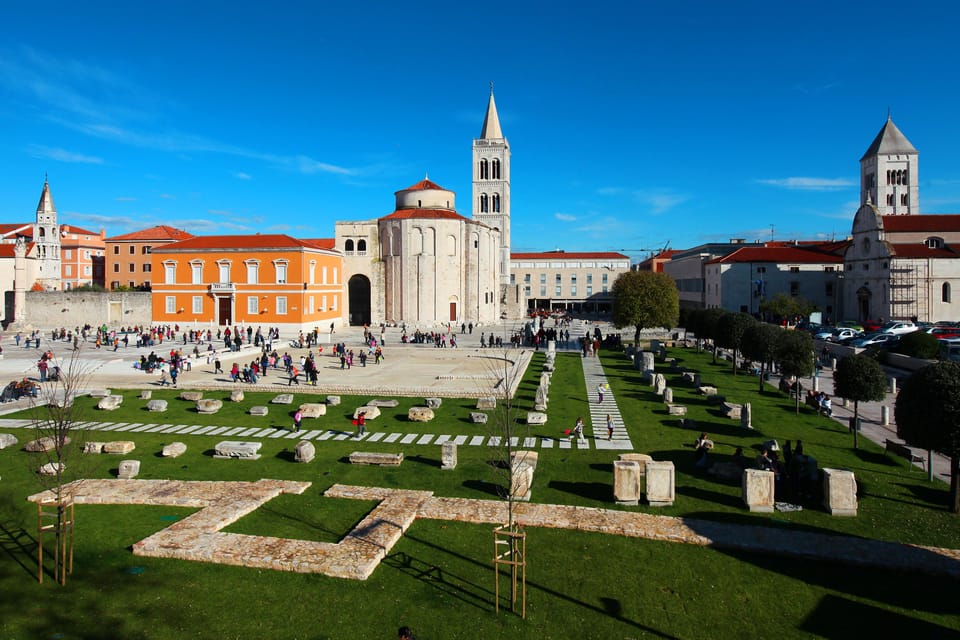
- Stop 4: The Forum—Roman ruins right in the middle of things
- Stop 5: Church of St. Donatus—an eye-catching rotunda in the Roman Forum
- Stop 6: Benedictine Monastery of St. Maria—religious art context without the ticket hassle
- Stop 7: Sea Gate (Morska vrata)—mix of Roman elements with 16th-century style
- Stop 8: Narodni trg—medieval square with a loggia and guard history
- Stop 9: Church of St. Simon—outside views plus the story of the sarcophagus
- Stop 10: Knezeva Palaca / Rector’s Palace—restored prince’s palace
- Stop 11: Five Wells—small square, easy-to-understand geometry
- Stop 12: Captain’s Tower—medieval crown walls without the ticket
- Stop 13: Perivoj kraljice Jelene Madijevke—early public park feel
- The end point changes: don’t plan an immediate connection
- Timing: 11 AM vs the later land gate start
- What you get for $32.67: value comes from the focus, not the tickets
- Practical logistics: walking, weather, and the one real risk
- Who should book this Zadar City Tour—and who should skip it
- Should you book it? My straightforward take
- FAQ
- FAQ
- How long is the Zadar City Tour walking experience?
- What does the tour cost per person?
- Is pickup included?
- Where do I meet the guide for the 11 AM tour?
- How does pickup work if I selected the option with pickup?
- Are there any entrances included in the tour price?
- Are tastings included?
- Is the tour suitable for children?
- Is it recommended for travelers with mobility issues?
- What about weather and cancellation?
Key things to know before you go
- Small group (max 16) for a more personal pace
- Two signature waterfront stops: Sea Organ and the solar Greeting to the Sun
- Roman ruins on the route: Forum and architecture around the peninsula
- Most religious buildings are view-only: you’ll learn outside, not rush inside
- Possible tastings: maraschino liquor and cheese may be added
- Weather matters: the tour requires decent conditions
Sea Organ and Greeting to the Sun: the route starts where the city gets weird (in a good way)
This tour is built around the idea that Zadar isn’t just pretty buildings. It’s also sound, light, and clever design you experience in real time. You’ll start at the seaside installations area, then gradually work your way through the Old Town core.
If you’re short on time, this is a strong use of your first day in Zadar. Instead of wandering and hoping you understand what you’re looking at, you get a guided path through the places you’d otherwise only half-notice.
You can also read our reviews of more tours and experiences in Zadar.


Finding your guide fast: the umbrella and the meeting point system
The meeting point is straightforward once you know what to look for. For the 11 AM session, your guide starts the tour in English and you should look for a guide holding a white ZADAR CITY TOUR umbrella and standing near the Greeting to the Sun solar installation area.
If you booked the option with pickup, you’ll be using a different logistics flow. You’ll look for a black minivan with a white ZADAR CITY TOUR logo, and the driver will have your name. Communication on pickup time and place happens strictly through platform messaging, email, or WhatsApp—so it’s worth checking your messages before you head out.
Cruise ship tip: Zadar has two ports. If your ship docks in the central area in front of the meeting point, you may not need the pickup.
Stop-by-stop: what each highlight is really like on foot

Stop 1: Greeting to the Sun and the solar system floor
You start with the Greeting to the Sun installation, and it’s more than a photo stop. The tour points you toward the solar panel concept represented in the installation—there’s a sense of modern engineering sitting right on the waterfront.
This is a great moment to get oriented. Once you’ve seen the guide’s explanation here, the rest of the day feels less like random sight-seeing and more like walking through a timeline.
Stop 2: Sea Organ—when the sea becomes the instrument
Next is the Sea Organ, one of Zadar’s signature installations. It’s designed as a staircase-like system that looks like a piano keyboard, and sound is created with the help of the sea moving air through pipes underneath the promenade.
You’ll spend about 10 minutes here, and that’s enough time to watch the rhythm of the water and understand why the sound happens. The key benefit is that the guide doesn’t just name it—they explain how the mechanism works so you actually get the point of why it’s famous.
If you’re thinking about timing: coming back near evening can be a treat, because the waterfront atmosphere changes and the installation’s story hits differently. (You’ll often see this idea mentioned, because it makes sense.)






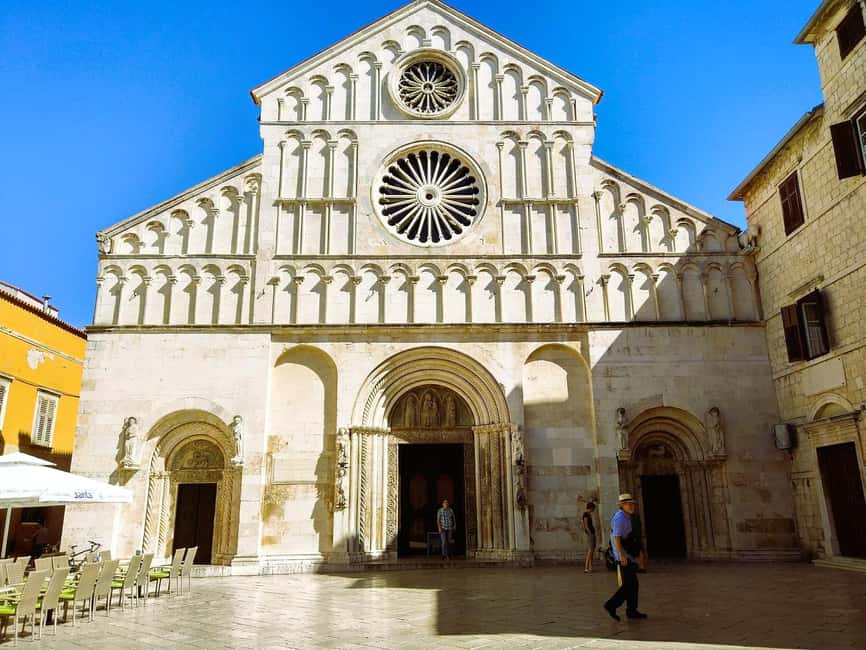
Stop 3: Cathedral of Saint Anastasia—big Romanesque presence from the outside
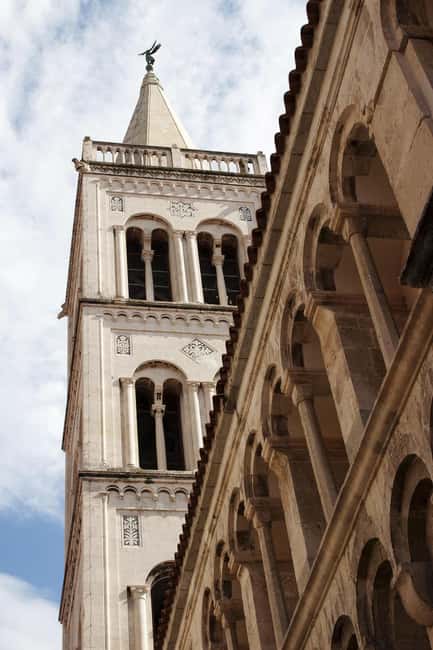
Then you move inland toward the Cathedral of Saint Anastasia, described as the biggest Romanesque church in Dalmatia. The body of the city patron Anastasia is kept here, but on this walk you don’t go inside.
That’s a trade-off: you’ll get history and context, not interior access. It’s still worth it because the exterior massing and the location help you understand why this part of Zadar mattered so much.
Stop 4: The Forum—Roman ruins right in the middle of things
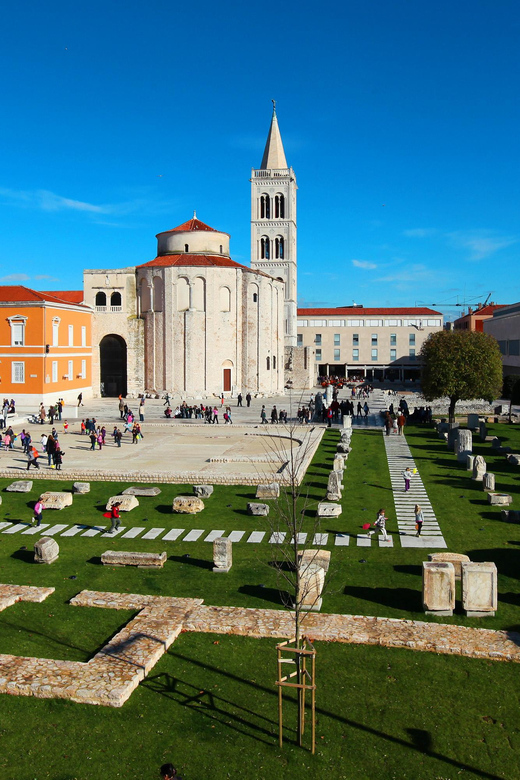
The Forum stop is one of the more “how did they build this?” moments. You’ll see the 1st-century BC Roman Forum area surrounded by remains of ancient Roman architecture.
This segment is valuable because it shows you Zadar’s geography and why the Roman period wasn’t just abstract—it’s physically present in the city layout. You’ll get a short 15-minute stop, so the guide keeps it focused and moving.
Stop 5: Church of St. Donatus—an eye-catching rotunda in the Roman Forum
St. Donatus is a star for a reason. It’s a 9th-century AC church in a pre-romanesque style, and it sits in the Roman Forum area like a huge rotunda.
Again, no entrance here. You’re there to view it and learn how it fits into the layers of Zadar’s past. Even from outside, it’s an easy structure to “read” once you’ve heard the story, especially if you like architecture more than museums.
Stop 6: Benedictine Monastery of St. Maria—religious art context without the ticket hassle
You’ll pass the 11th-century Benedictine feminine convent with a Renaissance church component. The stop includes mention of a permanent exposition of religious arts—but you don’t go in on this tour.
This works well if you don’t want to stack ticket lines on top of a walking itinerary. If you do want more, this is the kind of place you might return to later under your own schedule.
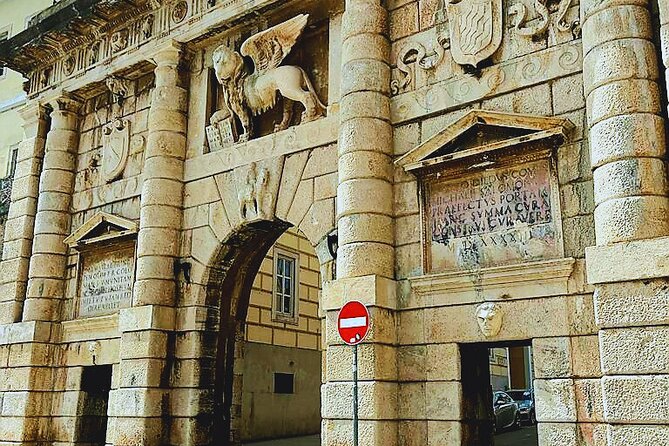
Stop 7: Sea Gate (Morska vrata)—mix of Roman elements with 16th-century style
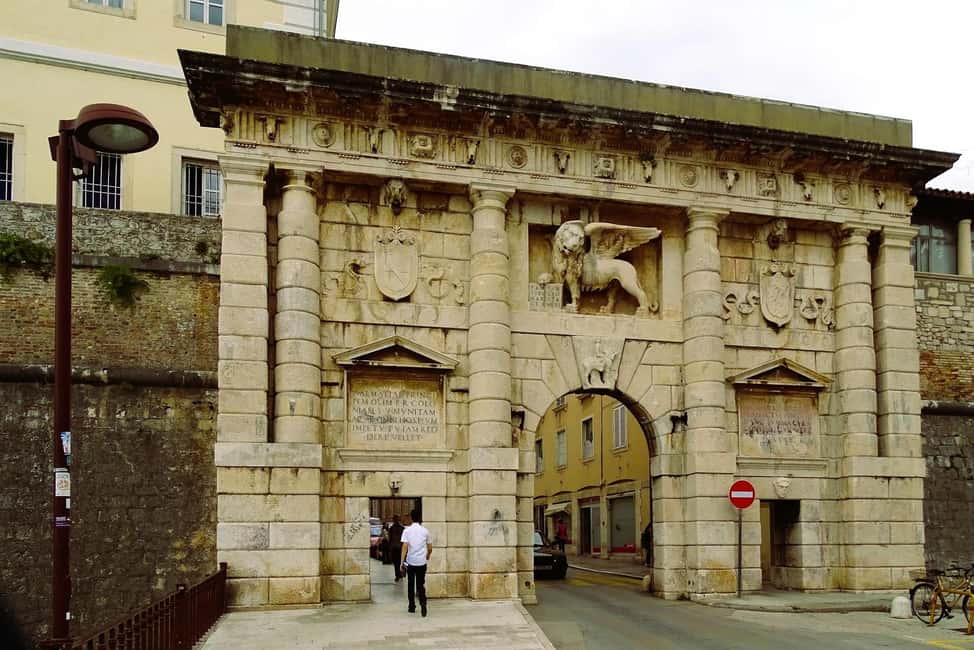
Next is the Sea Gate, a 16th-century gate with Roman elements. It’s one of those stops where the structure feels like a boundary marker—between the old coastal world and the inland streets.
The quick 10-minute stop is enough for photos and a clear explanation of what you’re seeing. If you like city gates and defensive architecture, you’ll appreciate that this walk includes it rather than skipping straight to the big churches.
Stop 8: Narodni trg—medieval square with a loggia and guard history
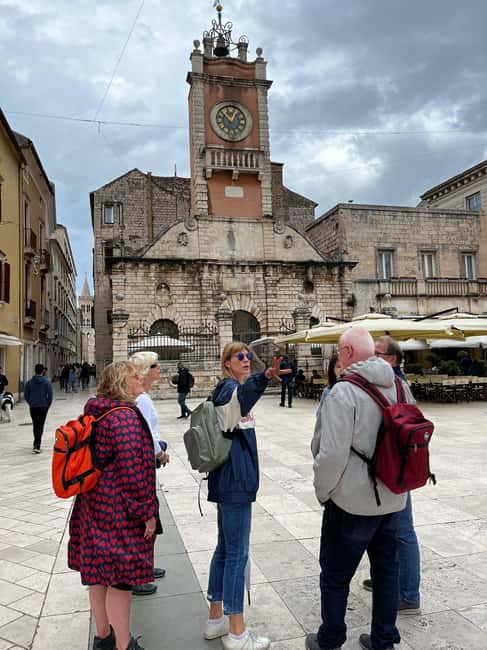
Narodni trg is a medieval square surrounded by 16th-century loggia and city guard context. It’s a slower-feeling pause after Roman and church stops.
This is also a good time for the kind of listening that doesn’t require you to keep craning your neck. It helps you “hold” the day in your head, instead of treating every stop as a sprint to the next photo.
Stop 9: Church of St. Simon—outside views plus the story of the sarcophagus
Church of St. Simon is another no-entrance stop, but it comes with a strong hook: it keeps the body of the saint inside a huge 14th-century sarcophagus, described as a goldsmith’s masterpiece.
You won’t see the interior on this walk, but the guide’s explanation makes it feel like a real place with real objects, not just an exterior facade.
Stop 10: Knezeva Palaca / Rector’s Palace—restored prince’s palace
You’ll see the recently restored Prince’s Palace, also known as Rector’s Palace Zadar. The tour notes it as a “see it from outside” stop—no entrance—so you’re learning how the building connects to the city’s ruling story.
This is a good moment to look around at the surrounding street grid. Restored buildings are often easiest to appreciate when you understand what role they played in daily power.
Stop 11: Five Wells—small square, easy-to-understand geometry
Five Wells is a Renaissance square with five well crowns. It’s brief—about five minutes—but it’s the kind of stop that keeps your eyes from glazing over after too many churches and ruins.
If you like little urban details, this is one of the better “breather” moments. It gives your legs a short reset without fully breaking the rhythm.
Stop 12: Captain’s Tower—medieval crown walls without the ticket
Then comes Captain’s Tower with medieval crown walls. Again, no entrance, but it’s still an interesting sight because towers like this were built to signal authority and control.
This stop is short (about five minutes), which is smart on a 2-hour tour. You don’t want “maybe I’ll come back someday” to become your whole day.
Stop 13: Perivoj kraljice Jelene Madijevke—early public park feel
You’ll reach Perivoj kraljice Jelene Madijevke, noted as one of the first public parks in Croatia. It’s a small pause and a change of pace from stone and gates.
This matters because the tour is compact. A quick patch of greenery gives your mind a reset, which makes the later history feel easier to absorb.
The end point changes: don’t plan an immediate connection
This activity ends in a different location from where it starts. The tour includes an end point that’s not the same as the meeting place, so it’s smart to build in a buffer if you’re catching transport or linking another plan right away.
If you’re trying to stack plans, I recommend scheduling something flexible within about an hour of the end, not immediately at the minute.
Timing: 11 AM vs the later land gate start
There are at least two start times mentioned: an 11 AM English tour near the solar installation area, plus an evening session that starts at 18:30 from the Land Gate area.
That evening option is useful if you’d rather shift your sightseeing earlier in the day for beach time and then do Old Town later. Even if you do the morning tour, thinking about a return near sunset to see the Greeting to the Sun in action is a logical add-on.
What you get for $32.67: value comes from the focus, not the tickets
At $32.67 per person for roughly two hours, the value is mainly in the guide and route design. Many of the top spots are view-only on this walk, so you’re not paying to get inside museums. You’re paying so you understand what you’re seeing as you move through the city.
The tour is also capped at 16 travelers, which is part of why it tends to feel personal. You’re not stuck behind a crowd, and the pace stays workable for different comfort levels—especially when guides build in shade or benches when they can.
Included possibilities are also part of the equation. The tour notes possible free entrance to a medieval church or maraschino and cheese tastings on the way. That’s a fun local touch that turns the history walk into something you can taste, not just see.
Practical logistics: walking, weather, and the one real risk
This is a walking tour, and the tour data flags it as not recommended for travelers with mobility issues and not suitable for children. The negative reviews I see for this kind of experience often tie back to meeting-point timing, and the same risk applies here.
Here’s how you reduce that risk:
- Arrive a little early and double-check the umbrella or the minivan logo if you booked pickup.
- Use the platform messaging or WhatsApp if anything changes.
- For cruise ships, confirm which port you dock at before assuming pickup is automatic.
Weather is another factor. The experience requires good weather, and if it’s canceled due to poor conditions, you’ll either be offered another date or a full refund. Since you’ll be outside for the whole route, you’ll be glad you planned with that in mind.
Toilets are not included. If you need one, handle it before you start.
Who should book this Zadar City Tour—and who should skip it
You should book if:
- You want an organized path through Zadar’s Old Town without getting lost.
- You like waterfront surprises like the Sea Organ and want the explanation behind how it works.
- You’re into Roman and medieval architecture and prefer guided context over ticket-heavy museums.
You might skip or choose something else if:
- Your mobility is limited or long walking routes are hard for you.
- You’re traveling with children, because the tour is not suitable for them.
- You want frequent breaks, bathroom stops, or frequent interior visits. This walk is mostly view-based.
Should you book it? My straightforward take
If your goal is a smart first introduction to Zadar—Roman ruins, signature waterfront art, and the main church-and-square stops—this tour is an excellent match. For the money, the best part is that you leave with a story you can actually repeat while walking through town on your own.
If you’re prone to rushing or hate strict meeting points, just take the timing seriously. Show up early, confirm messages, and treat it like a guided appointment. Do that, and you’ll get a smooth, efficient Old Town overview without feeling like you spent your day stuck in a line.
FAQ
FAQ
How long is the Zadar City Tour walking experience?
It’s listed as about 2 hours (120 minutes).
What does the tour cost per person?
The price is $32.67 per person.
Is pickup included?
Pickup is offered only if you book the option with pickup. Otherwise, you meet the guide at the central starting point.
Where do I meet the guide for the 11 AM tour?
Look for a guide with a white ZADAR CITY TOUR umbrella near the Greeting to the Sun installation representing the solar system.
How does pickup work if I selected the option with pickup?
Look for a black minivan with a white ZADAR CITY TOUR logo. The driver will have your name on paper. Pickup timing and location are communicated via platform messaging, email, or WhatsApp.
Are there any entrances included in the tour price?
Some stops are listed as free to view, but entrances that require tickets are not included. Several churches/monuments are marked as no entrance on this walk.
Are tastings included?
The tour notes possible free tastings on the way, such as maraschino/cheese tastings or a free entrance to a medieval church, depending on what’s included.
Is the tour suitable for children?
No. It is not suitable for children.
Is it recommended for travelers with mobility issues?
It is not recommended for travelers with mobility issues.
What about weather and cancellation?
The tour requires good weather. If it’s canceled due to poor weather, you’ll be offered a different date or a full refund.