REVIEW · PULA
Pula: The evening tour
Book on GetYourGuide →Operated by Acta Est Fabula · Bookable on GetYourGuide
Roman Pula hits different at dusk. This 90-minute evening walk strings together the city’s top Roman leftovers and the stories behind them, guided by a licensed German guide born in Pula. I love how it starts at the Pula Arena and keeps you moving into the Forum’s political heart, not just ticking off monuments.
The one drawback is the pace: most stops get about 10 minutes, so you’ll need to treat it like a guided overview and plan extra time if you want to linger. Also, admission fees aren’t included.
In This Review
- Key highlights worth your attention
- A 90-minute Roman highlights loop through the center
- Meeting under the Arena roof: where the story begins
- Pula Arena: the only arena in Croatia
- Tito’s Park and the Twin Gate: city layers in walking order
- Gate of Hercules and the Arch of the Sergii: power you can read
- Mosaic: The Punishment of Dirce
- Forum: the heart of ancient Pula
- Temple of Augustus: the most beautiful and oldest in Croatia
- Price and value: why $29 can work
- What kind of traveler this tour fits best
- Should you book the Pula evening tour?
Key highlights worth your attention
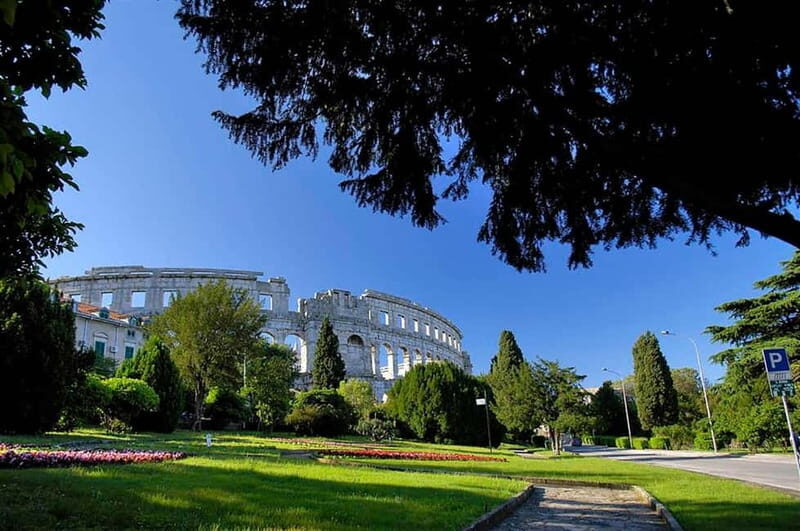
- Pula Arena, the only arena in Croatia: start where the spectacles happened.
- Forum focus: you’ll get a clear sense of how the city’s core functioned.
- Temple of Augustus: the tour spotlights what’s described as the most beautiful and oldest temple in Croatia.
- Roman entrances and monuments: Twin Gate, Gate of Hercules, and the Arch of the Sergii show power in stone.
- A story-driven route: you’ll hear explanations about symbols like the Istrian flag’s billy goat and even why ties come into the conversation.
- Licensed, German-language guiding: very good German, plus an insider’s Pula perspective.
A 90-minute Roman highlights loop through the center
This tour is built like a smart evening snack: enough time to see the major anchors of Roman Pula, short enough to keep your feet from getting cooked. In 90 minutes, you cover the Arena area, several key gates and arches, a standout mosaic, then finish at the Forum—so your mental map of the old city forms quickly.
What I like most is the way the guide uses questions to make the monuments feel less like ruins and more like living evidence. The opening idea—bread and circuses—sets up a simple way to read the Arena. After that, each stop adds a new layer: civic space at the Forum, emperor-era religious presence at the Temple of Augustus, and “how the city branded itself” through its symbols and architecture.
One more practical point: because the tour is timed, it’s ideal for people who want a strong overview. If you’re the kind of person who needs 30+ minutes at every wall, you’ll still enjoy it, but you may want to add solo time later.
You can also read our reviews of more evening experiences in Pula



Meeting under the Arena roof: where the story begins
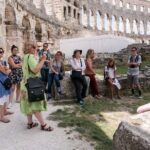
You meet in front of the entrance to the arena, under the wooden roof. That matters because you’re starting at one of the tour’s main characters, not at some random spot in town.
The guide’s approach is also a big part of the value here. This isn’t just a checklist with dates. A licensed guide born in Pula brings local context, and that usually changes the tone: you hear how the city’s identity carries through from the ancient sites to today. In my book, that’s what turns Roman sightseeing from distant to personal.
Because the tour is German-language, your comfort level with German will shape your experience. The guide’s German is described as very good, which helps a lot. If you don’t speak German, you can still follow the visuals and monument names, but you’ll lose some of the connective storytelling.
Pula Arena: the only arena in Croatia
The tour begins with a guided look at the Pula Arena (about 20 minutes). The headline is clear: it’s the only arena in Croatia, which instantly makes it worth your attention even before you get into details.
This is where the bread-and-circuses concept becomes more than a line in a book. An arena is entertainment infrastructure. It shows how power and public life were linked—how the city could keep people engaged, how spectacles worked as social glue. Even if you only catch a few key points, you’ll leave with a better “why” than a photo alone.
A practical tip for this stop: take a minute to orient yourself visually before you listen. Arches, openings, and the flow of space are easier to understand when you know what you’re looking at. Then you can enjoy the guide’s explanations without feeling lost.
Tito’s Park and the Twin Gate: city layers in walking order
After the Arena, the route shifts to Tito’s Park for a short guided stop (around 10 minutes). This break is useful. It gives you a reset between the arena’s Roman spectacle and the city’s entrance monuments that come next. It’s also a reminder that Pula isn’t frozen in antiquity—later periods still shape the streets and viewpoints you see while walking.
Then you head to the Twin Gate (about 10 minutes). A “twin” gate suggests symmetry and design, and that’s where your guided overview helps: gates often weren’t just for getting in. They were statements about identity—control, access, and status. Even without going deep into technical terms, you can pick up how the city organized movement.
If you’re traveling with limited time, this portion is a strong value. You get multiple “what is it and what did it do” explanations in one sweep, so the monuments don’t feel random.
Gate of Hercules and the Arch of the Sergii: power you can read
Next up is the Gate of Hercules (about 10 minutes), followed by the Arch of the Sergii (about 10 minutes). Two stops like this are perfect for learning to read Roman messaging in stone.
A gate with a named figure (Hercules) nudges you toward the idea that mythology and identity were practical tools. Names and symbols told people who mattered and what values were being celebrated. Then the arch—another kind of monument built to mark something important—helps you see how honor, authority, and memory were displayed.
Here’s how you can get more out of it without needing a textbook: look for visual hierarchy. Notice what gets emphasized in shape and placement. That’s usually where the “message” sits. The guide’s storytelling does the rest, turning shapes into meaning.





Mosaic: The Punishment of Dirce
The tour includes Mosaic: The Punishment of Dirce (about 10 minutes). Even if you only spend a short time here, a mosaic rewards attention. It’s not just decoration; it’s storytelling in image form.
In a timed walking tour, mosaics can be easy to under-appreciate because you’re moving. So give this one a proper look for a minute before the guide moves on. Try to catch the overall scene first, then follow any pointers about figures or action. That way, the mosaic becomes a highlight rather than a brief stop between bigger monuments.
This is also a good moment to slow down mentally. After gates and arches, a mosaic shifts you from architecture to narrative art. That variety helps keep the 90 minutes from feeling repetitive.
Forum: the heart of ancient Pula
The Forum is one of the tour’s biggest reasons to book. You get a guided look at it (about 10 minutes), and the tour also finishes here. The Forum is described as the heart of ancient Pula, and the route is built to bring you there after you’ve seen the other “entry and identity” landmarks.
This stop is where the city starts to make sense as a system. Rome didn’t just build monuments; it built spaces where civic life happened—where people gathered, where power was displayed, and where daily routines played out under monumental backdrops. With the guide’s explanation, the Forum becomes more than a square with ruins. It becomes the stage.
If you’re trying to understand Roman Pula at a glance, the Forum is your anchor. After this, you’ll likely feel like you could point to where the city’s main energy would’ve been.
Temple of Augustus: the most beautiful and oldest in Croatia
Next you’ll visit the Temple of Augustus, Pula for about 10 minutes. The tour calls it the most beautiful and oldest temple in Croatia, and that claim alone makes it a must-see anchor.
A temple stop works best when you treat it as more than “Roman building.” It represents religious and political messaging wrapped together. You’re looking at a structure tied to authority and worship at the same time. Even if your knowledge of the emperor cult is basic, the guide’s context helps you see what that pairing meant for people living in the city.
One practical thing: don’t rush the lines and proportions. Temples can feel visually similar when you see them quickly, but once you notice the details the guide points out, the uniqueness becomes easier to grasp. This is the part of the tour where a short window can still leave a big impression.
Price and value: why $29 can work
At $29 per person for a 90-minute licensed guided walk, the value mostly comes from two things: time efficiency and the guide quality. You’re paying for someone who can connect the dots quickly—Arena to Forum, gates to identity, mosaic to storytelling—so you spend your time looking at monuments instead of figuring out what they were.
Two cost notes that matter:
- Admission fees aren’t included, so you may need to budget extra if entry is required for certain stops.
- Because the tour is short, it’s strongest if you’re okay with a guided overview. If you want slow museum-style wandering, you’ll likely want to pair this with independent time later.
If you’re visiting Pula with a limited schedule, this is a smart use of an evening. It gives you a coherent Roman core in one go, with local context added by a Pula-born guide.
What kind of traveler this tour fits best
This tour works especially well for:
- First-timers in Pula who want the Roman highlights in one compact evening.
- People who enjoy story-based guiding, not just architecture spotting.
- Anyone curious about how the city’s symbols and identity connect across time, including fun topics the guide brings up (like ties and the Istrian flag’s billy goat).
It may be less ideal if:
- You need long stays at each site.
- You only want English-language narration (the live guide here is German).
- You strongly prefer tours that include admissions in the base price.
Should you book the Pula evening tour?
If you want a guided shortcut to understanding Roman Pula, I’d say yes. The route is logical, the Forum and Temple of Augustus are treated as key anchors, and the guide’s local perspective is the kind of detail that makes monuments easier to remember. The German language component is the main thing to check first—make sure you’re comfortable following the narration.
Also, go in expecting a brisk overview. If you do that, you’ll come away with a clear sense of the city’s structure, plus a few memorable “why does that matter” moments that you can carry into the rest of your trip.