REVIEW · SPLIT
Split Walking Tour with Professor of History
Book on Viator →Operated by Split Walking Tour with History Professor · Bookable on Viator
Roman walls start at the water. Starting near Porta Aenea, you’ll walk with a history professor through Split’s most important layers, and I love how the explanations turn stone corridors into a real sense of daily life. I also like that the group stays small, so you can ask questions and actually keep up instead of just drifting past plaques.
One possible drawback: two of the biggest “wow” churches are outside-only during the tour, and their entry isn’t included. If you want to go inside, plan a little extra time later for your own visit.
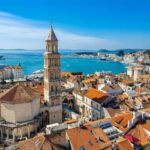
You’ll cover the story of Split fast but not rushed, moving from Riva Harbor to the Roman core and then into medieval and Renaissance-era squares where local life still happens.
In This Review
- Key highlights at a glance
- Brass Gate to Riva Harbor: Start Where Daily Life Flows
- Diocletian’s Substructures: The Best-Preserved Parts You’ll Walk Through
- Peristyle Square to the Imperial Hall Logic
- Saint Domnius and the Jupiter Temple: Big Stories Without Entering
- Saint Domnius from the outside
- Temple of Jupiter’s conversion story
- Golden Gate to Gregorius: Power, Legend, and Sculpture
- Prokurative and Fruit’s Square: When Officials Became Everyday Life
- What Makes the History Professor Format Work
- Is It Good Value for $24.19?
- Should You Book This Split History Walking Tour?
- FAQ
- How long is the walking tour in Split?
- Where do you meet, and does the tour end there too?
- Is the tour offered in English?
- Are entrance tickets included for Saint Domnius and the Temple of Jupiter?
- How big is the group?
- What if the weather is bad or I need to cancel?
Key highlights at a glance
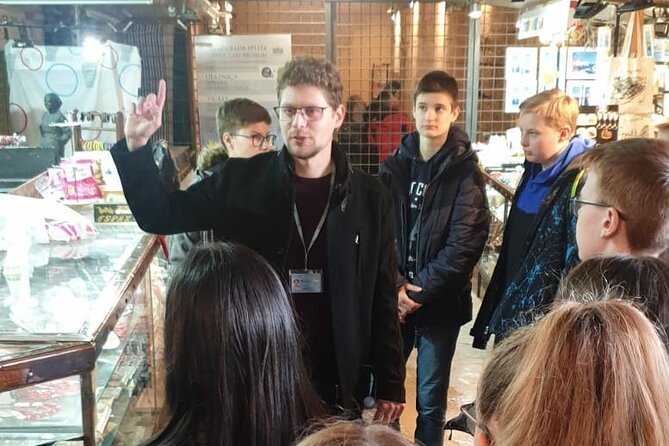
- Professor-led context for Diocletian’s Palace so you don’t just look at ruins, you understand what they meant
- Small group limit (max 17) with room for questions and better back-and-forth
- UNESCO World Heritage focus on the parts of Split that truly define the city’s identity
- Hands-on local folklore like the Gregory of Nin toe-rubbing good-luck tradition
- Free viewing at most stops, with only select entrances not included
- Practical tips from guides (food, where to go next, and sometimes even ATM/bank advice)
Brass Gate to Riva Harbor: Start Where Daily Life Flows
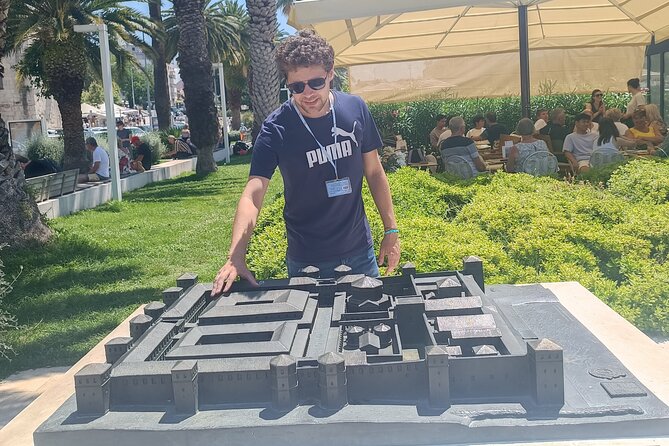
The tour begins at Brass Gate, also called Porta Aenea, on the waterfront side of Split’s old town. From there, you shift quickly into the rhythm of the city: coffee breaks, sun time, and the kind of street energy that makes the historic center feel alive.
Riva Harbor is a smart first stop because it anchors your eyes. Before you hit the big Roman structures, you get a feel for where locals actually spend time. Your guide uses that contrast to frame what you’ll see next: Diocletian’s palace built a world of power, but today you’re walking through the everyday front room of Split.
This opening also helps you settle in. With a small group (max 17), it’s easier to orient yourself, keep track of directions, and start learning right away instead of waiting until later.
You can also read our reviews of more tours and experiences in Split.


Diocletian’s Substructures: The Best-Preserved Parts You’ll Walk Through
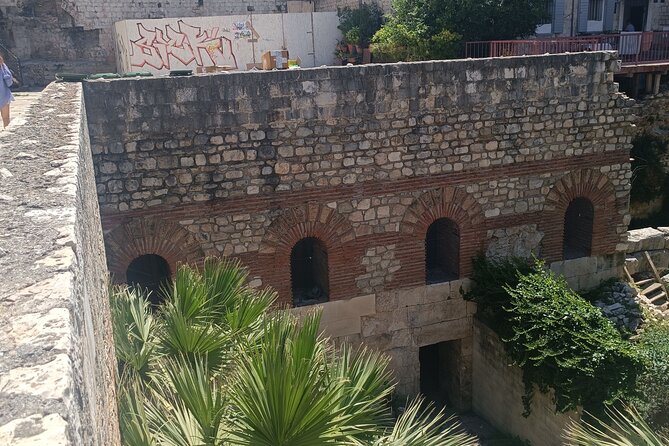
Next comes the heart of the experience: the Diocletian Palace substructures—the basement halls that sit beneath the palace life above. This is one of the world’s best-preserved complexes from classical antiquity, and it’s a big reason Split’s historic center earned UNESCO status in 1979.
I love that these spaces change how you picture the palace. Instead of thinking only in terms of decorative columns and grand entrances, the tour makes you notice the engineered weight of the place—how the underground spaces supported the whole complex. Even if you’ve seen Roman ruins before, this site has a specific “how did they build this?” feel that sticks.
Practical note: this is a walking tour, so you’ll be moving fairly quickly. The upside is you’ll see the substructures as part of a timeline, not as a disconnected stop.
Peristyle Square to the Imperial Hall Logic
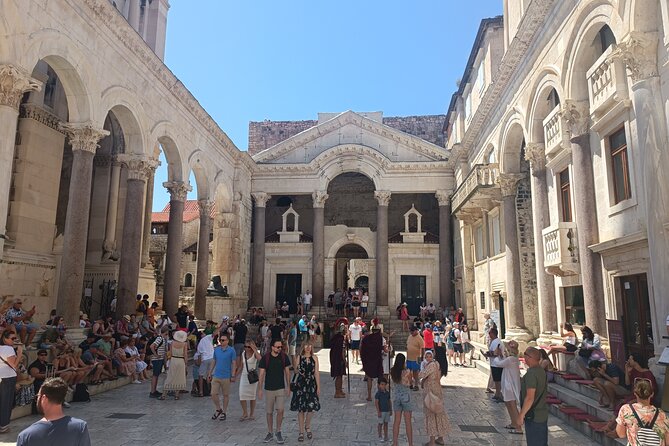
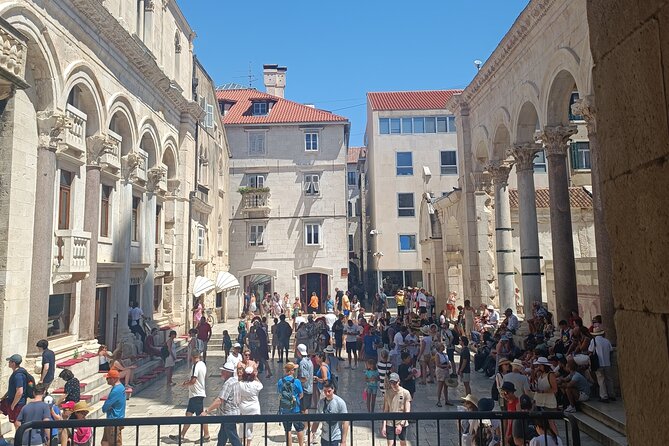
From the underground levels you rise into the central stage of the palace: the Peristyle, a square that functioned as the palace’s main public area. Your guide explains how it connected to the emperor’s role—Diocletian as a living son of Jupiter, appearing as people approached beneath the architrave.
What makes Peristyle click is the way the tour turns space into choreography. You learn why the central square mattered, how the architecture guided movement, and why religious imagery and authority were mixed together in plain sight. That’s when Split stops feeling like random stone and starts feeling like a designed system.
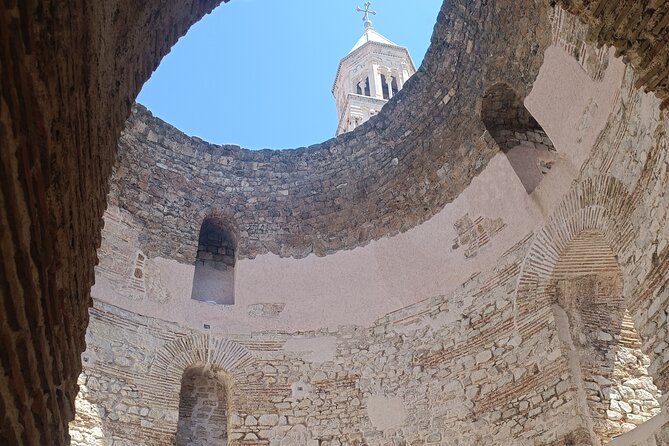
A few steps later you reach the Vestibul, also known as the Rotonda. It’s the first section of the imperial corridor, and it’s built as a circular hall that originally was topped with a dome. The guide points out the key dimensions—about 17 meters high and 12 meters in diameter—and explains its role as a grand meeting hall for select audiences like ambassadors.
If you care about how rulers used space, this part is worth paying attention to. If you just want photos, you’ll still get good visuals, but the real value is how the guide teaches you to look.
Saint Domnius and the Jupiter Temple: Big Stories Without Entering
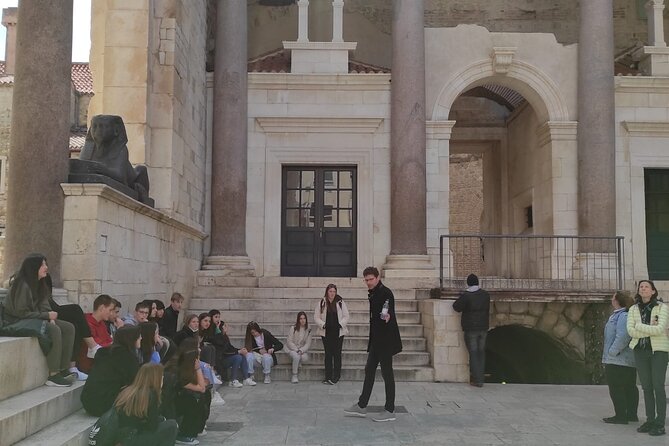
Two of the tour’s most important sites are handled differently: Saint Domnius and the Temple of Jupiter. During the walk, you view both from the outside, and entrance isn’t included. You’ll get detailed context during the stop, and your guide may point out that you can visit inside later on your own if you want.
Saint Domnius from the outside
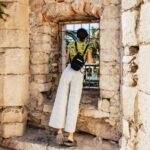
Saint Domnius is described as a Roman temple, mausoleum, and church—depending on how you look at it. That layered identity is exactly why this stop matters. The guide helps you read the building as a history document: how functions change, how older structures become new sacred spaces, and how Split kept reusing what already had weight and meaning.




Temple of Jupiter’s conversion story
Then comes the Temple of Jupiter. The tour frames Jupiter as the supreme sky-and-thunder god in ancient Roman religion. Over time, that sacred space got converted into a baptistery dedicated to St. John the Baptist, and you’ll hear what that shift meant culturally.
Outside-only doesn’t mean you’ll feel shortchanged. The stop is paired with a clever street interlude: on the way to the Golden Gate, you’ll pass a narrow lane locals call the Let Me Pass Street, described as the narrowest street in the world. The contrast—big imperial temples and tiny medieval-scale streets—helps you understand how Split compressed centuries into a walkable footprint.
Golden Gate to Gregorius: Power, Legend, and Sculpture
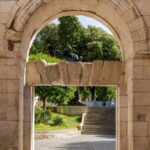
As you move deeper into the old town, you hit the Golden Gate, also known as the Northern Gate. It’s one of the four principal Roman gates into Split’s old town, built as part of Diocletian’s palace. The guide explains how it served as the main entry point through which the emperor entered, with decoration that marked the gate’s importance.
A key part of the story is the gate’s Middle Ages chapter: it was sealed off and lost columns and statuary. In modern times, it was reopened and repaired, which is why you see the structure today as both ruin and revival.
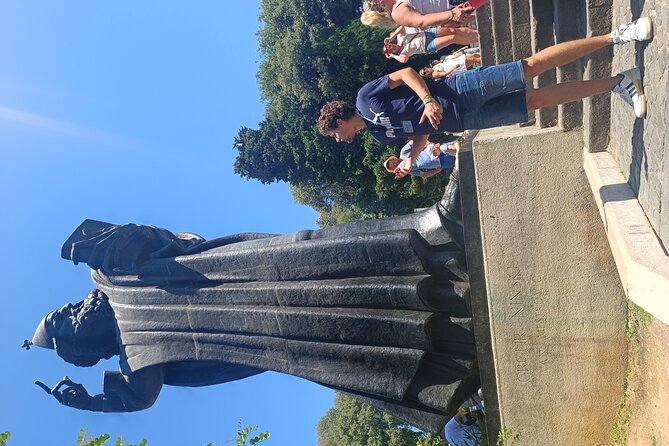
Right after, the tour shifts to a different type of monument: the Grgur Ninski statue by Ivan Meštrović. This is where folklore becomes physical. The statue is about 8.5 meters tall, and the guide points out that people rub the toe for good luck. You can literally see the effect—its toe is worn smooth from generations of touching.
Then you walk to Marmontova Ulica, a street named after Napoleon’s marshal Marmont. The guide explains the irony: even though Marmont is a conqueror, Split’s citizens named their beautiful street after him for the urbanisation he brought to Dalmatian cities. It’s a reminder that history isn’t always clean moral labeling—it’s often practical cause-and-effect.
Prokurative and Fruit’s Square: When Officials Became Everyday Life
By the time you reach Prokurative, you’re shifting from palace drama to civic space. Prokurative is Republic Square, a large open area lined on three sides with neo-Renaissance buildings. Your guide uses this pause to connect the Roman story to later periods, showing you how architecture keeps changing but the city’s habit of gathering in public squares stays consistent.
Then you finish at Fruit’s Square (Trg Brace Radic). This is a small, pretty square tied to daily commerce—especially when women used to sell fruit here. The guide adds history with a cultural marker: you’ll hear about the statue of Marko Marulić, described as the father of Croatian literature.
This final stop is also where the tour tends to feel most like a local conversation. Your guide is likely to connect monuments to what you can do next: where to eat, what to look for after you leave the group, and how to pace your time so you get more out of the city rather than just collecting landmarks.
What Makes the History Professor Format Work
The biggest reason this tour earns such high praise is the way the guide teaches. Guides like Mario and Anita are repeatedly described as proud of Croatian heritage, quick with fun facts, and good at mixing big-picture context with specific street details.
In practice, that means you get more than a list of sites. You learn the “why” behind what you’re seeing:
- why Diocletian’s palace space worked like a system
- why later religious buildings often reused earlier sacred structures
- why small features—like the worn toe of Grgur Ninski—matter because people keep turning history into habit
You also get a group dynamic that helps. With a cap of 17 people, the tour can keep questions flowing. In some sessions, the guide even builds room for extra stories and may run a bit longer if the conversation is lively. One consideration for your schedule: the advertised time is around 2 hours 20 minutes, so I’d plan your evening with a little buffer in case you land closer to three hours.
Finally, the better guides don’t just talk history. They offer practical next steps. From the experiences shared, guides sometimes recommend food and nearby stops, and a few even share useful local logistics like which ATMs/banks to use and which ones to avoid.
Is It Good Value for $24.19?
At $24.19 per person, this is priced like a smart entry-level history walk, but it’s also closer to a “best tour for your first day” than a long, complicated excursion.
Here’s why it can feel like value:
- Most stops are free to view during the tour.
- The route covers multiple top-tier palace and old-town landmarks in one go.
- You get guided interpretation that helps you understand UNESCO-level architecture without needing to study guidebooks first.
- Small-group format usually means less waiting, more interaction, and fewer people to share attention with.
The main “cost” isn’t money—it’s that two major sights are outside-only here, with entrance not included. If you’re the type who always wants to go inside, plan to add a personal visit after the tour.
Also, the tour can include an upgrade to a private tour if you want a more personalized experience. That can be a good move if you’re traveling as a couple or family and want more tailored pacing and questions.
Should You Book This Split History Walking Tour?
If you’re visiting Split and want your bearings fast, I’d book this. The route is designed to show you what defines the city: Diocletian’s palace core, the Roman-to-medieval story, and the public squares where later periods left visible fingerprints.
Book it especially if:
- You like learning about place through architecture and context.
- You want a professor-led explanation instead of a fast “look at this, next” route.
- You’re okay with outside viewing for Saint Domnius and the Temple of Jupiter, knowing you can visit later on your own.
Skip it or adjust your plan if:
- You mainly want ticketed interiors and don’t care about outside architecture and interpretation.
- You have a tight schedule where an extra 30 minutes would break your day.
Overall, this is a strong first-time Split pick: you get a coherent story, not scattered facts, and you finish with enough direction to keep exploring confidently on your own.
FAQ
How long is the walking tour in Split?
It’s about 2 hours 20 minutes (approx.).
Where do you meet, and does the tour end there too?
You meet at Brass Gate (Porta Aenea), Obala Hrvatskog narodnog preporoda 22, 21000 Split. The tour ends back at the meeting point.
Is the tour offered in English?
Yes, it’s offered in English.
Are entrance tickets included for Saint Domnius and the Temple of Jupiter?
No. During the tour, you view Saint Domnius and the Temple of Jupiter from the outside, and entrance is not included. You’d need to pay if you choose to visit inside after.
How big is the group?
The tour has a maximum group size of 17 travelers.
What if the weather is bad or I need to cancel?
This experience requires good weather. If it’s canceled due to poor weather, you’ll be offered a different date or a full refund. You can cancel for a full refund up to 24 hours in advance.