REVIEW · SPLIT
The Best of Split Private Tour
Book on Viator →Operated by Jelena Vrancic Private Tourist Guide · Bookable on Viator
Split’s Old Town is made for walking. This private tour threads Roman, Venetian, and modern Split into one practical loop, starting at the Riva and focusing on Diocletian’s Palace. I especially like having a guide who can explain what you’re actually looking at and then point you to local daily-life spots like the Green Market. If you want a fixed, tick-box route with zero flexibility, this is less your style, because the pace can adjust for the group.
You also get the kind of personal touch that shows up in the reviews: people repeatedly mention guides like Vinka and Kristina being attentive, upbeat, and ready with recommendations after the tour. The best part is how the walk keeps you in motion through alleys, squares, and gates, so Split clicks fast. One consideration: the tour is still mostly on foot in stone streets, so plan comfortable shoes and expect some uneven ground.
In This Review
- Key Highlights at a Glance
- A Private Walk Through Split’s Roman Core
- Entering Diocletian’s Palace Substructures (and Why It Matters)
- The Vestibule: Ceremonial Doorway to Power
- Cathedral of Saint Domnius: When a Mausoleum Becomes a Landmark
- The Peristyle: Split’s Colonnaded Courtyard Feeling
- Green Market, Golden Gate, and the Stuff Locals Actually Use
- City Clock, Fruit’s Square, and the Venetian Layer
- Prokurative and the Riva Harbor Finish
- How the Included Admission Changes the Value
- Who This Tour Is Best For (and Who Should Skip It)
- Meeting at the Riva: Easy Start for Old Town Days
- The Most Praised Parts That You’ll Feel on Day One
- Should You Book This Best of Split Private Tour?
- FAQ
- How long is the Best of Split private tour?
- What is the price per person?
- Is pickup offered?
- Where do we meet for the tour?
- Is this tour private?
- What language is the tour offered in?
- What’s included in the tour price?
- What admissions are not included?
- Is a mobile ticket used?
- Is there free cancellation?
- Is the tour suitable for people with limited mobility?
Key Highlights at a Glance
- Diocletian’s Palace focus with timed stops across substructures, the vestibule, and key public spaces
- A guide you can ask questions to in real time, not just hear a monologue
- Old Town daily life stops like the Green Market and neighborhood squares
- Photo-worthy architecture stops including the Peristyle and the Golden Gate area
- A local finish at the Riva so you can carry the day forward on your own
A Private Walk Through Split’s Roman Core
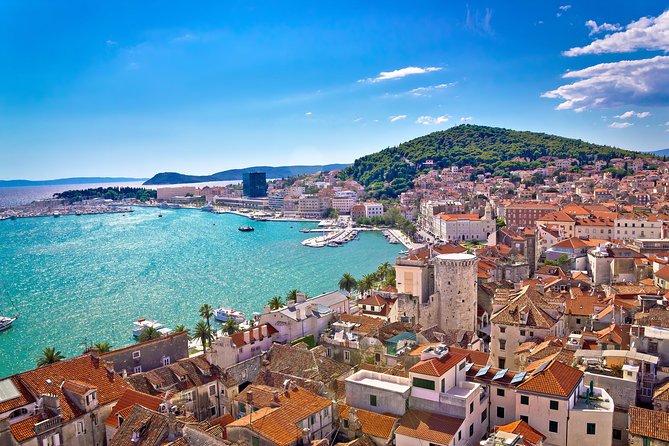
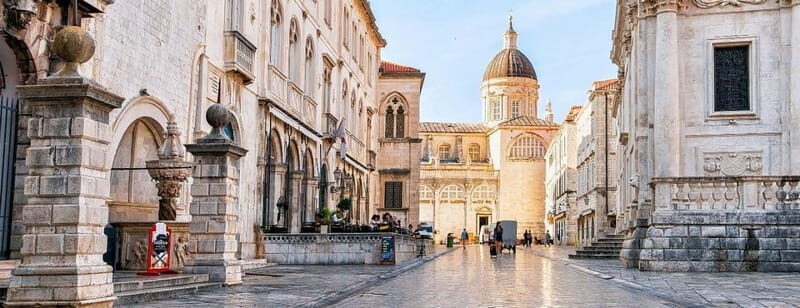
Split does not give you its story from a single viewpoint. It gives it to you by layers: Roman walls and halls, later medieval and Venetian adaptations, and today’s people filling squares, cafés, and the waterfront promenade.
That’s why I like this format. It’s a private walking tour with a licensed local guide, timed at about 2 hours 30 minutes, and it moves you through the Old Town so you see how the city grew around Diocletian’s Palace. The included entry for the palace substructures also means you spend less time sorting tickets and more time understanding what you’re standing on.
If you’ve ever walked through a historic site and felt like you were reading a page without the caption, this is the cure. You’ll learn how spaces were used, what the architecture signals, and how modern Split still works with those same urban bones.
You can also read our reviews of more tours and experiences in Split.


Entering Diocletian’s Palace Substructures (and Why It Matters)
Stop one is the Diocletian Palace Substructures, and that is the right place to start. Even if you know Diocletian’s Palace is important, the substructures are where scale becomes real. This is your first chance to understand that the palace isn’t just a pretty ruin—it’s a whole system of spaces built into the earth and supporting the life above.
You get about 45 minutes here, and importantly, the admission fee is included. That inclusion helps value, because many palace tours either make you add entry costs later or shorten the time once inside.
What you’re walking through is basically the physical foundation of the palace. You’ll connect later stops back to this first scene. It’s the kind of start that makes the rest of the Old Town feel less random and more like one continuous layout.
Practical consideration: this part is inside and could feel cooler than the sun outside. Wear layers if you’re touring in hot weather, and give your eyes time to adjust from bright streets into stone interiors.
The Vestibule: Ceremonial Doorway to Power
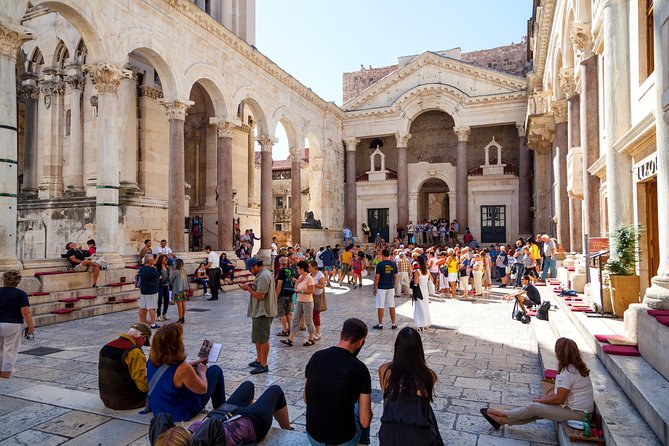
Next comes the Vestibulum of Diocletian’s Palace, described as the hall linked to ceremonial access for the emperor. This is a shorter stop—about 15 minutes—but it helps you connect the tour from underground supports to formal movement through the palace.
The big value here is context. When you understand what a vestibule was for, the palace layout stops being a set of isolated attractions. You start seeing routes: where someone would have been welcomed, where authority was staged, and how architecture guided movement.
Admission here is listed as free, so you get the benefit without extra ticket planning. If you like architecture that has a job to do, not just a look, this stop will feel like it earns its spot.
Cathedral of Saint Domnius: When a Mausoleum Becomes a Landmark
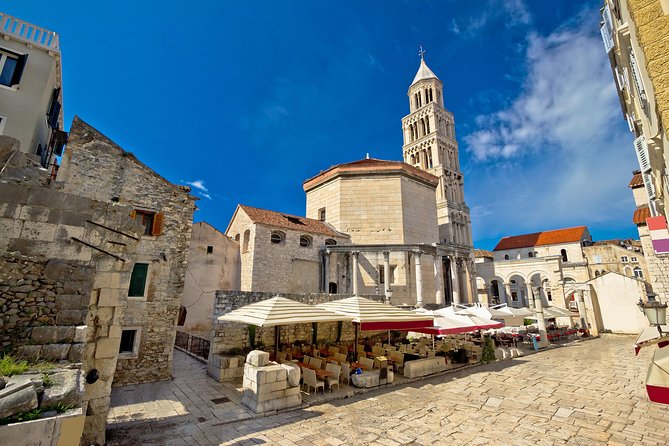
Stop three is the Cathedral of Saint Domnius, housed in what was formerly the emperor Diocletian’s mausoleum. The building is monumental and from the 4th century, so it dominates the central area of the palace.
Time here is about 15 minutes, and the admission is not included. That matters for your planning: if you want to step inside for the full effect, you’ll need to pay that separate entry cost during the tour.
The tradeoff is still fair. You get guided framing for the setting, plus the freedom to decide whether you want to pay for the mausoleum experience portion. If you’re trying to keep costs down, you can focus on what’s visible from your guided route and spend your money where you’ll enjoy it most.
The Peristyle: Split’s Colonnaded Courtyard Feeling
The Peristyle of Diocletian’s Palace is one of those spaces that makes your brain go quiet for a second. It’s a ceremonial entrance court framed by monumental arcades, oriented toward the imperial loggia, and it’s surrounded by the kind of colonnaded geometry you only get from major empires.
This stop is about 10 minutes and has free admission. That quick timing is smart. The courtyard is visually heavy, and you want time to look without turning the whole tour into a slow crawl.
If you like photography, this is where you’ll want a few extra seconds. If you like people-watching, keep your eyes moving too—because this kind of space attracts both history lovers and casual walkers, and watching how they flow through the square tells you something about how today uses old architecture.




Green Market, Golden Gate, and the Stuff Locals Actually Use
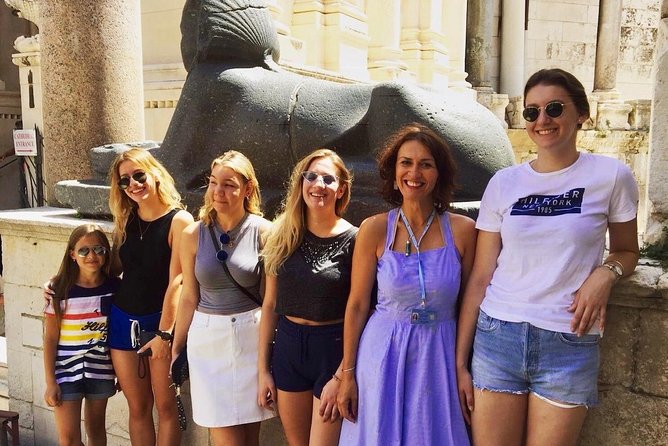
After the palace core, the tour shifts to street-level Split—where history becomes practical life.
You hit the Green Market next. It’s where locals buy fruit and vegetables and where you can find the kind of food pairing people rave about: cheese and prosciutto. This is about 10 minutes and free, and it’s one of my favorite parts because it grounds the city in real routines.
Then comes the Golden Gate, the most prominent of the palace gates. The description includes a small church of St. Martin built into the gate in the 5th century. This is another short 10-minute stop with free admission, but it adds an extra layer: religion and civic movement living in the same stone doorway.
You finish the palace exterior details with the Grgur Ninski Statue, a bronze work by Croatian sculptor Ivan Meštrović. There’s even the classic local good-luck tradition of rubbing the statue’s toe. It’s only 5 minutes, but this is a great reminder that Old Town culture is not just about standing still.
City Clock, Fruit’s Square, and the Venetian Layer
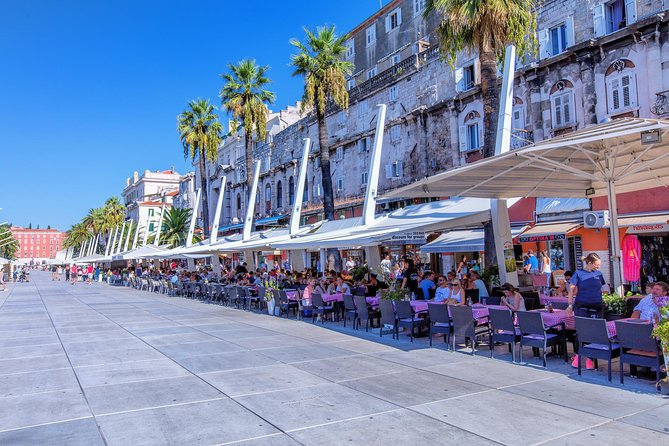
A tour that only covers the Roman layer feels incomplete in Split, because later powers kept building and remodeling in the same footprint.
Next is the City Clock, built into the western gate. It’s listed as recognizable today, and it’s a good way to see continuity. You’re looking at a landmark that survived multiple eras of the city’s use.
Then it’s Fruit’s Square (Trg Brace Radic). This is just 5 minutes, but it’s positioned outside the palace and helps you understand how daily commerce and movement spilled beyond the imperial walls. There’s also a statue of Marko Marulić, described as the father of Croatian literature, centered in the square.
Immediately after, you get a quick look at the Venetian tower, the remains of a 15th-century Venetian castle dominating Fruit Square. It’s another 5 minutes, free, and short on purpose—so you can clock the shift in influence without losing time.
Prokurative and the Riva Harbor Finish
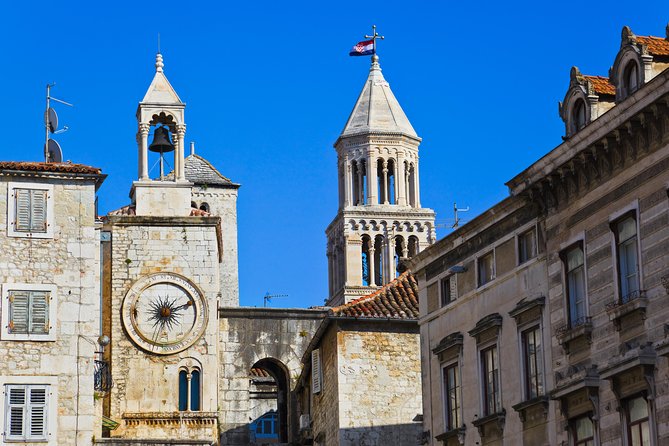
Now you move toward the waterfront atmosphere. This is where Split stops feeling like a museum and starts feeling like a place you could live.
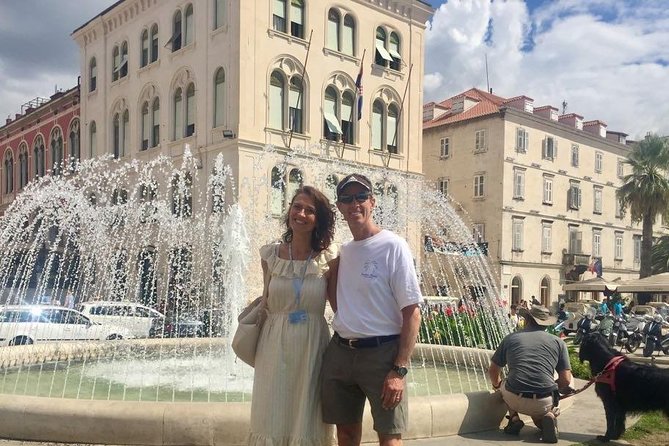
The tour includes Prokurative, also known as Republic Square. It resembles Venice’s St. Mark’s Square according to the description, and it’s lined with neo-Renaissance buildings. You’ll also get a view toward the harbor and the Riva, and the tour notes that the square is open on the south side.
Finally, the tour ends at the Riva Harbor, framed as the most beautiful promenade in Croatia and a meeting point for both locals and visitors. This is about 10 minutes, free, and crucial for your day plan. Ending here makes sense because it’s an easy place to transition from guided history to your own food, stroll, and sunset.
How the Included Admission Changes the Value
Let’s talk value, because the $199.62 per person price is only easy to judge if you compare what you actually get.
You’re paying for:
- A local licensed guide
- A custom-made program and tour organization
- Admission fee included for Diocletian’s Palace substructures
You’re not paying for:
- Mausoleum & Jupiter’s Temple optional entry listed at €8.00 per person
- Cathedral of Saint Domnius entry (not included)
So the tour is not forcing you into every ticket. It gives you the one entry that supports the tour’s core story (the substructures), and it gives you options for the rest based on your interests and budget.
Also, it’s private. That matters if you’re a family, a couple, or a small group that wants questions answered and timing adjusted. Reviews repeatedly highlight pace adjustments and patience—especially when someone had knee problems, a cane, a baby in the group, or multiple generations with different interests.
If your ideal tour is fast facts and quick photos, you can do that with a group bus. But if your ideal tour is understanding why the city feels the way it does, the private format is where your money goes.
Who This Tour Is Best For (and Who Should Skip It)
This tour shines if you:
- Want to understand Roman Split without needing a history degree
- Prefer a guided walk through squares and narrow streets
- Like mixing architecture with everyday life, like the Green Market
- Travel as a group where one pace might not fit everyone
- Are short on time and want the major highlights without guessing your way through
It may not be the best choice if you:
- Want a slow, long museum-style experience with minimal walking
- Prefer large-group experiences that can be cheaper and more social
- Only care about one specific era and want deep time in that single topic
The itinerary is designed to hit key sites and connect them. If you treat it like a curated route rather than a slow wander, it lands well.
Meeting at the Riva: Easy Start for Old Town Days
This tour is built for arrival days, especially cruise stops. The meeting point is the main waterfront at Riva, specifically at Obala Hrvatskog narodnog preporoda 23, near the bronze map of the city.
You’ll also meet cruise ship guests at the port. And if you’re staying inside the Old Town, pickup can be arranged at your apartment or hotel. For places outside the Old Town, the meeting point remains the Riva.
Start times are on request for private tours, which is handy if you’re juggling ship schedules, dinner reservations, or heat.
Bring comfortable shoes. The area is walkable and the route is manageable for most travelers, but stone streets and small turns add up in 2.5 hours.
The Most Praised Parts That You’ll Feel on Day One
Here’s what stands out most from the strongest feedback trends, and why it matters to you:
Pace and comfort. Multiple reviews mention guides adjusting for walking limits, babies, and mixed ages. That translates into a tour that feels less like you’re being dragged and more like you’re being guided.
Questions get answered. People repeatedly call out the guide’s ability to explain history in an easy-to-follow way and to handle curiosity without shutting it down.
Extra local value. Beyond the major sites, guides are praised for pointing out food and view spots, and for taking time to include market and shop stops that don’t usually make the highlight-only versions.
Personal connection. Names like Jelena, Vinka, Kristina, Sanda, Ana, and Vicencija come up in reviews as standout hosts. While you can’t choose your exact guide from this information alone, the overall pattern is clear: guides who know Split as a living city, not just a list of monuments.
Should You Book This Best of Split Private Tour?
Yes, if you want a fast, smart orientation to Split’s Old Town that balances Roman architecture with modern life. You’ll get an expert guide, a walk that makes sense geographically, and an included ticket for the palace substructures so your time starts paying off immediately.
Book it if you’re:
- Short on time (2.5 hours is a sweet spot)
- Interested in Roman and Venetian layers
- The type of traveler who loves markets and street-level details, not just plaques
Skip it if you’re only after one monument and prefer deep-entry ticketing or long independent time.
My practical advice: wear shoes you can stand in, bring a question or two about what you’ve already seen in Split, and plan to extend your day at the Riva afterward. This tour sets you up to explore with your eyes open.
FAQ
How long is the Best of Split private tour?
It lasts about 2 hours 30 minutes.
What is the price per person?
The price is $199.62 per person.
Is pickup offered?
Yes. Pickup is offered, and it can be arranged for stays inside the Old Town of Split. For those outside the Old Town, the meeting point is the Riva waterfront.
Where do we meet for the tour?
The default meeting point is Obala Hrvatskog narodnog preporoda 23, 21000 Split, near the bronze map on the Riva. Cruise ship guests meet at the port.
Is this tour private?
Yes. It’s a private tour/activity, and only your group participates.
What language is the tour offered in?
The tour is offered in English.
What’s included in the tour price?
A local licensed guide, custom-made tour organization, and the admission fee for Diocletian’s Palace substructures.
What admissions are not included?
Admission to the Mausoleum & Jupiter’s Temple is optional at €8.00 per person, and Cathedral of Saint Domnius admission is not included.
Is a mobile ticket used?
Yes, the tour uses a mobile ticket.
Is there free cancellation?
Free cancellation is available up to 24 hours before the experience start time.
Is the tour suitable for people with limited mobility?
Service animals are allowed, the tour is near public transportation, and the listing says most travelers can participate. The tour is still a walking route through Old Town streets.