REVIEW · SPLIT
Essential Diocletian’s Palace Tour for First-Time Visitors
Book on GetYourGuide →Operated by KUKUVIA, Vl. Jelena Tanjić · Bookable on GetYourGuide
Fourteen centuries walk right beside you. This 90-minute small-group tour through Diocletian’s Palace is a fast way to understand why Split is unlike other seaside cities, and it stays fun the whole time thanks to Jelena Tanjić’s energetic, story-driven guiding.
I love two things most. First, the way Jelena turns hard-to-grasp palace history into clear scenes you can picture as you walk, with humor and lots of group questions. Second, the small group size keeps it relaxed, so you’re not just herded from stone to stone. One consideration: the tour is not suitable for wheelchair users, so you’ll want to judge your comfort with uneven, old-town terrain.
In This Review
- Quick Facts That Help You Plan
- What Makes This Palace Tour Worth Your Time
- Why Diocletian’s Palace Can Feel Like a Real Split Neighborhood
- Meeting Gregory of Nin and Getting Oriented in Minutes
- Golden Gate and People’s Square: The Palace’s Main Public Face
- Jupiter’s Temple and the Peristyle: Power, Religion, and Everyday Scale
- Cathedral of Saint Domnius: Where the Centuries Overlap
- Vestibule Area and the Egyptian Sphinx: The Moment You’ll Actually Remember
- Diocletian’s Cellars: Underground Cool and a Clear Expected Limit
- Finish at the Split Riva: Your Launchpad for the Rest of the Day
- Price and Value: Why $41 Feels Fair for First-Timers
- Who Should Book, and Who Might Want a Different Option
- Should You Book This Diocletian’s Palace Tour?
- FAQ
- How long is the Diocletian’s Palace tour?
- Where do I meet the guide?
- What’s the group size?
- Is the tour offered in English?
- What are the main places you visit?
- Does the tour include a selfie moment?
- Are there any discounts during or after the tour?
- Is it suitable for wheelchair users?
Quick Facts That Help You Plan

- Price: $41 per person
- Duration: 90 minutes
- Group size: up to 10 people
- Language: English
- Meeting point: in front of the Monument to Gregory of Nin, at the north entrance to the Palace called the Golden Gate (look for a black umbrella)
What Makes This Palace Tour Worth Your Time
- Jelena’s story format** makes the palace feel readable, not confusing. You get cause-and-effect, not just dates.
- Focused stops cover the palace’s public spaces and key religious sites, plus the cellar area.
- Vestibule Dome selfie is a proper, fun memory moment, not a rushed afterthought.
- Real-life Split tips come after the tour, including where to eat and what to see next.
- Discount vouchers give you a practical reason to keep exploring right away.
You can also read our reviews of more tours and experiences in Split.


Why Diocletian’s Palace Can Feel Like a Real Split Neighborhood
Diocletian’s Palace isn’t a museum set behind glass. It’s the original shell of a Roman complex that got reused, reshaped, and lived in for centuries. You feel that right away when you start at the entrance points and follow the lines of streets and squares that grew out of the palace plan.
The biggest win of this tour is that you don’t just collect facts. You walk a route that explains how the palace worked as a power center, then how parts of it turned into everyday city life. That shift is the whole story of Split, and the guide keeps pulling you back to that idea: same stone, different centuries.
And yes, it’s UNESCO World Heritage. You’ll hear why it matters once you understand what you’re standing inside.
Meeting Gregory of Nin and Getting Oriented in Minutes
Your start is easy to find: the Monument to Gregory of Nin, right at the north entrance to the palace called the Golden Gate. The guide will be holding a black umbrella, which is a small but smart detail. In old cities, that kind of visibility saves time and stress.
From the first steps, Jelena frames the whole place. You get a clear sense of what you’ll see and why each stop fits. That matters, because Diocletian’s Palace is big, and without a map in your head you can waste the first hour wandering.
Also, this is built for first-timers. The pace is “walk and understand,” not “walk and memorize.”
Golden Gate and People’s Square: The Palace’s Main Public Face
You begin with the Golden Gate, the obvious starting “threshold” for the story. From there you move into the palace’s main civic areas, including People’s Square, also known as Pjaca in many contexts.
This is where you get the palace’s first big lesson: Roman design wasn’t only about grandeur. It was about movement, access, and how people entered spaces that mattered. When you stand where the flow of traffic and sightlines meet, the whole place becomes easier to interpret.
What I like about this section is that it stays human. You’re not just looking at architecture; you’re learning how the space would have worked, then how it works now with shops and city life around you. It’s a strong setup for everything else you’ll see later, including the religious sites and the underground cellars.
Jupiter’s Temple and the Peristyle: Power, Religion, and Everyday Scale
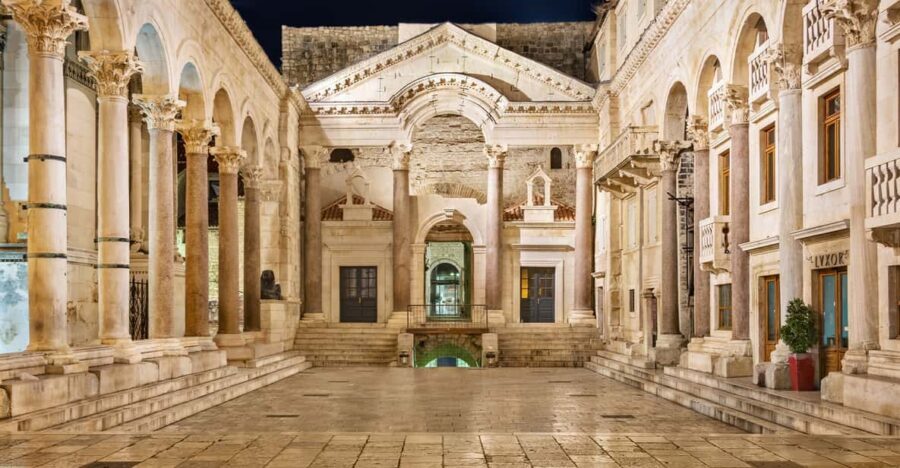
Next comes Jupiter’s Temple and the Peristyle. These stops are the “big impact” parts of the route. In Roman terms, this is where authority and belief were designed to look permanent.
Here’s the practical value for you: once you understand what these spaces were meant to project, you’ll start noticing the symbolism in what survives. Even if you’re not a history person, the guide helps you see why people cared about these rooms and courtyards in the first place.
The Peristyle is also a great reality check. You’re surrounded by scale that can feel intimidating until someone puts it in plain language. You’ll likely find that the tour format makes the space less overwhelming, because you get a walkable explanation instead of a lecture from a single spot.




Cathedral of Saint Domnius: Where the Centuries Overlap
The Cathedral of Saint Domnius is one of Split’s key landmarks, and this tour treats it as more than a photo stop. The cathedral connects the palace-era story to later layers of Split’s identity, so you understand why these buildings stayed meaningful as the city changed.
A helpful detail to know in advance: you don’t go into the cathedral monastery/mausoleum area. Instead, you learn about it from outside. That’s not a dealbreaker, but it’s good to set expectations so you don’t feel like you’re missing a room once you’re nearby.
If you’re doing Split for the first time, this is where the tour starts to click. The palace becomes more than Roman architecture. It becomes a framework that later generations shaped into the city you see today.
Vestibule Area and the Egyptian Sphinx: The Moment You’ll Actually Remember
One of the tour’s standout features is the Vestibule area, with a group dome selfie moment. This is genuinely fun, and it’s timed at a point where the setting is photogenic. It’s also a nice break in the middle of the walking—one reason the tour stays lively instead of turning into pure sightseeing fatigue.
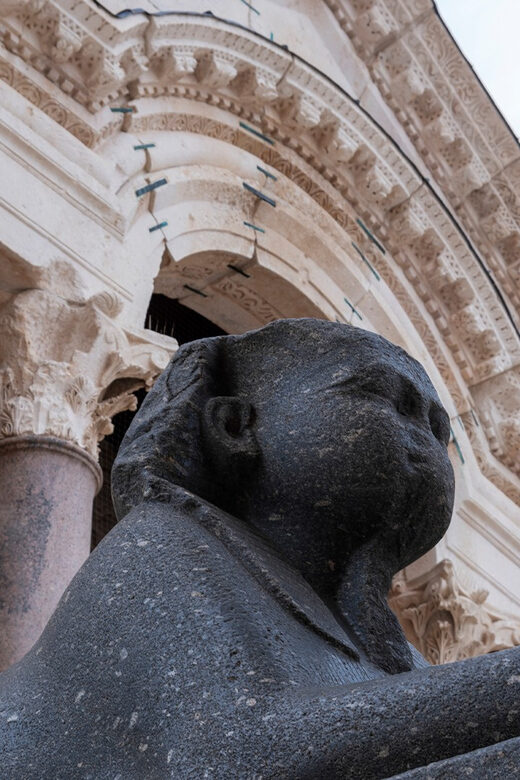
Right around here, you’ll also learn about the Egyptian sphinx, a detail that many people miss on their own. Seeing it through the guide’s explanation helps it make sense in the larger story of the palace environment. It’s one of those objects that sounds like trivia until you understand why it’s there and what it represents in context.
This section works best if you like mixing architecture with odd-but-true details. It’s the kind of stop that turns into a memorable conversation later when you’re sitting down to dinner.
Diocletian’s Cellars: Underground Cool and a Clear Expected Limit
Then you head to Diocletian’s Cellars. This is where the tour takes a noticeable turn from “sunlit monuments” to the heavy, underground atmosphere of the palace’s inner workings.
From the way the experience is described, you go into the cellar area itself. One important expectation: you don’t include the museum portion. You’ll get the cellar experience, but you won’t be doing a full standalone museum visit inside this tour slot.
In practical terms, this works well because you get a sense of how the palace supported life and storage, without turning the whole day into a ticket-and-timetable project. You still end with daylight and energy for the rest of Split.
Also, this tour is designed to keep moving without feeling rushed. In at least some groups, the guide is attentive about basic comfort like water, shade, and bathroom breaks, which matters more than people think in August heat.
Finish at the Split Riva: Your Launchpad for the Rest of the Day
The tour ends at Split Riva, the famous waterfront promenade. Finishing here is smart, because it gives you an immediate “what next” path: sit, snack, and plan.
Even though the tour is short, it comes with extra value. The guide shares a list of recommendations tailored to what you’ve just seen, plus where to eat and what local experiences are worth your time. That matters if you want to avoid the usual trap of spending the next two hours searching on your phone.
And there’s one more practical perk: you get access to vouchers for selected well-known restaurants and bars, with discounts tied to your tour. That’s not just a gimmick. It’s a concrete way to save money when you’re deciding where to eat after walking for 90 minutes.
Price and Value: Why $41 Feels Fair for First-Timers
$41 for a 90-minute small-group walk may sound like a “yes, but is it worth it” number. Here’s what makes it feel reasonable for this particular experience.
You’re paying for three things at once:
- A licensed guide who explains the palace layout and meaning in a way that’s easy to follow.
- A tight route through the essential landmarks you’d otherwise need a plan to string together.
- Bonus perks: the Vestibule selfie moment, plus vouchers and personalized food and sight suggestions.
The big value angle is that this tour helps you avoid the early-mistake problem. On your own, you might spend time figuring out what’s essential and what’s optional. With a guide, your time is already organized around the palace’s story.
If you’re in Split for only a day or two, that time value matters most.
Who Should Book, and Who Might Want a Different Option
This is a strong fit if you:
- Are visiting Split for the first time and want a clean introduction to Diocletian’s Palace and the city around it
- Prefer walking tours with conversation and questions, not silent photo stops
- Want a simple plan for what to do after the tour, including meal ideas
It may not be the best fit if you:
- Need wheelchair-friendly access, since the tour is not suitable for wheelchair users
- Want a full, ticket-based deep museum experience (this route focuses on key areas and includes the cellar area, but not the museum portion)
Also, note that there are limited view areas in this tour. For example, the substructures and bell tower aren’t part of what you’ll cover, and the St. Domnius monastery/mausoleum is discussed from outside rather than entered. If your priority is those specific interiors, you’ll want to plan separate time.
Should You Book This Diocletian’s Palace Tour?
Yes, I’d book it if you want a first-time Split orientation that stays upbeat and practical. The route hits the palace’s main anchors—Golden Gate, Peristyle, Saint Domnius, the Vestibule area, and the cellars—then lands you at the Riva with a built-in game plan for the rest of your day.
You should skip or reconsider if you’re comfortable doing this on your own with a guidebook and you specifically want the areas this tour doesn’t enter. And if you need step-free access, this one isn’t for you.
If you’re the type of traveler who likes history explained in plain language, with humor and a human guide behind the facts, this tour is a solid bet.
FAQ
How long is the Diocletian’s Palace tour?
The tour runs for 90 minutes.
Where do I meet the guide?
Meet in front of the Monument to Gregory of Nin, at the north entrance to the Palace called the Golden Gate. Look for a black umbrella.
What’s the group size?
It’s a small group limited to 10 participants.
Is the tour offered in English?
Yes, the live tour guide provides the tour in English.
What are the main places you visit?
You’ll visit key stops including the Golden Gate, People’s Square (Pjaca), Jupiter’s Temple, the Peristyle, the Cathedral of Saint Domnius, the Vestibule area, Diocletian’s Cellars, and you finish at Split Riva.
Does the tour include a selfie moment?
Yes. There’s a group selfie in the Vestibule area (Vestibule Dome).
Are there any discounts during or after the tour?
Yes. You get access to vouchers and discounts for some of Split’s renowned restaurants and bars, plus recommendations for where to eat and what to see.
Is it suitable for wheelchair users?
No. The tour is not suitable for wheelchair users.