REVIEW · PULA
Pula Private 2-Hour Guided Walking Tour
Book on Viator →Operated by Istria Tours · Bookable on Viator
Roman Pula clicks into place on foot.
This private 2-hour guided walk is built for you to steer: you choose what to linger on and what to skip, while a Pula resident explains what you’re seeing in plain terms. You also get the advantage of skipping the usual tourist bottlenecks and lines, because the guide works the route around your pace.
Two things I really like: first, the stop at the Amphitheatre de Pula can be paired with quick entry help—your guide can arrange tickets at the entrance so you’re not stuck waiting. Second, after the tour you get useful local direction, including recommendations for olive oil and what to eat nearby, which helps the whole day in Pula feel less random.
One thing to consider: the walking adds up and Pula has hills, and during hot weather you’ll want to plan for shade breaks. The tour is a good match for moderate physical fitness, but it’s not a sit-down sightseeing package.
In This Review
- Key points
- A two-hour Roman sprint with room to steer
- Where the tour starts: Pula Arena to the Twin Gates
- Stop-by-stop: Amphitheatre de Pula without the hassle
- Venetian Fortress viewpoints over Pula harbor
- Pula Cathedral: a 5th-century anchor (inside if open)
- Tempio di Augusto and the forum area: Augustus meets later city life
- The Punishment of Dirce mosaic: Roman art at floor level
- Arco dei Sergi and the Roman city-gate feeling
- Gate of Hercules and the Twin Gates: standing in the old entrances
- Gradska Trznica Pula: market reality and a local rhythm
- Walking comfort: hills, heat, and how the guide helps
- Price and value for a small private group
- Final verdict: should you book this Pula private walking tour?
- FAQ
- How long is the Pula Private 2-Hour Guided Walking Tour?
- Is this tour private?
- What language is the tour offered in?
- Where do we meet and where does the tour end?
- Is the Amphitheatre de Pula entrance fee included?
- What if the Pula Cathedral is closed?
- Do we need to pay for the mosaics and Roman gates?
- What is the cancellation policy?
Key points
- Private, 2-hour route control so you can focus on the sights that matter to you
- Amphitheatre de Pula ticket help that can cut down your waiting time
- Old-town route efficiency with major Roman Pula sights in one smooth run
- Views included from the Venetian Fortress over the harbor area
- Roman street-level details like the Dirce mosaic and city gates you can actually stand under
- Market stop at Gradska Trznica Pula when it’s open, for a real local feel
A two-hour Roman sprint with room to steer
If you’re trying to see Pula’s “greatest hits” without turning it into a full-day march, this tour’s format makes sense. You’re getting a guided walk that’s tightly timed—about 2 hours—but still flexible enough that you can ask for more time at the stops that catch your eye.
That flexibility matters in Pula because the sights are close enough to walk, but they don’t all feel the same. Some are best as quick orientation (gates, arches, exterior viewpoints). Others beg for attention at your own speed (like when you’re standing at Roman ruins and want the story behind the stone).
The tour is offered in English, and it’s private—so you’re not stuck following the loud group rhythm. Your guide can also slow down when the terrain gets hilly, which shows up in the feedback from people who did the walk in real conditions.
You can also read our reviews of more tours and experiences in Pula.


Where the tour starts: Pula Arena to the Twin Gates
The meeting point is at Pula Arena (Flavijevska ul., 52100, Pula), and the walk ends at the Twin Gate (Carrarina ul. 8, 52100, Pula). Practically, that’s helpful because you don’t feel like you’re retracing your steps just to “finish the tour.”
The listed tour window is 12:00 PM–2:00 PM (Monday through Sunday). If you’re visiting in the warmer months, that midday timing is something to plan around—think water and shade breaks.
Also note the tour uses a mobile ticket, which is convenient when you’re moving fast and don’t want another paper thing to manage. And because it’s a private group capped at up to 15, you’re not dealing with a huge crowd surge mid-walk.
Stop-by-stop: Amphitheatre de Pula without the hassle
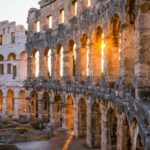
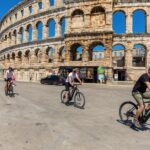
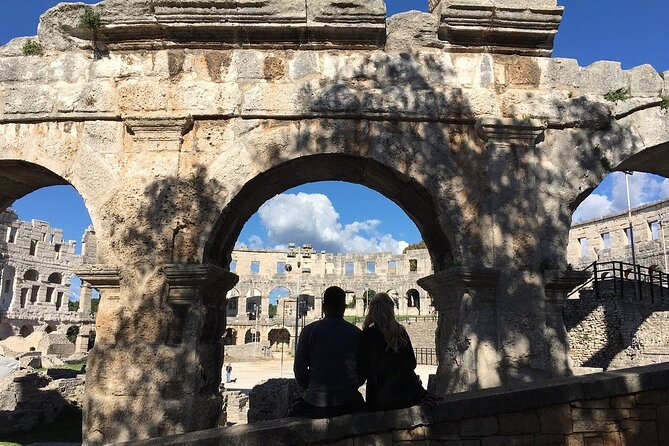
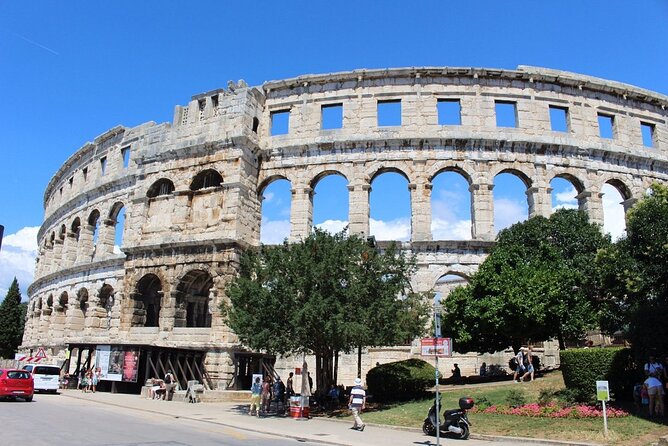
The tour’s first major anchor is the Amphitheatre de Pula, a structure from the 1st century AD. This is the kind of place where your brain instantly wants to picture the spectacle—gladiators, crowds, and the sheer scale—but you’ll get more out of it with someone pointing out what to notice.
Here’s the key decision: you can either enter the amphitheater or stay outside. If you want to go in, the guide can buy the entry tickets at the entrance, and the idea is that you won’t be stuck in a long queue. Amphitheatre admission is not included in the tour price, and it’s listed as €10.00 per person.
If you choose not to enter, you’ll still get an explanation from outside with enough context to make the building make sense. For short on time days, the outside option can work well because the exterior lines already tell a lot.
Based on feedback tied to this stop, people really value that “fast entry help” part. It’s a small detail, but in a site like this, saving even a chunk of waiting changes your whole experience.
Venetian Fortress viewpoints over Pula harbor
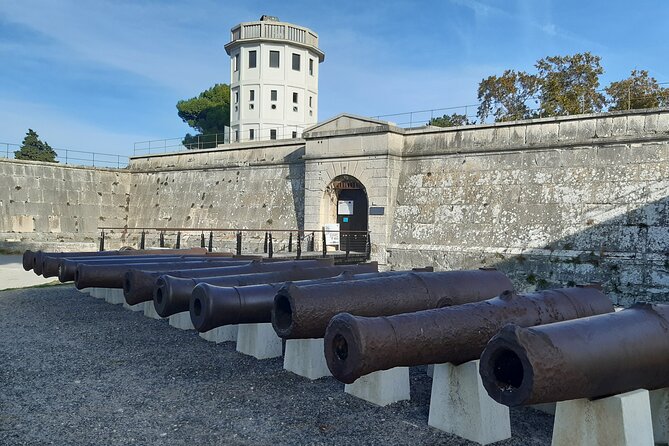
Next you walk toward the Venetian Fortress—a 17th-century structure overlooking the harbor area. This stop is shorter (about 15 minutes) and it’s mostly about perspective.
Why it’s worth it: Roman Pula is great, but Pula isn’t just Roman. The fortress viewpoint helps you connect the medieval/Venetian layer of the city to where the power and shipping would have mattered. Even if you don’t climb much, standing where you can see the harbor gives your earlier ruins context.
The tour does this in a way that doesn’t eat your time. You get the view, the explanation, and then you move on.
Pula Cathedral: a 5th-century anchor (inside if open)

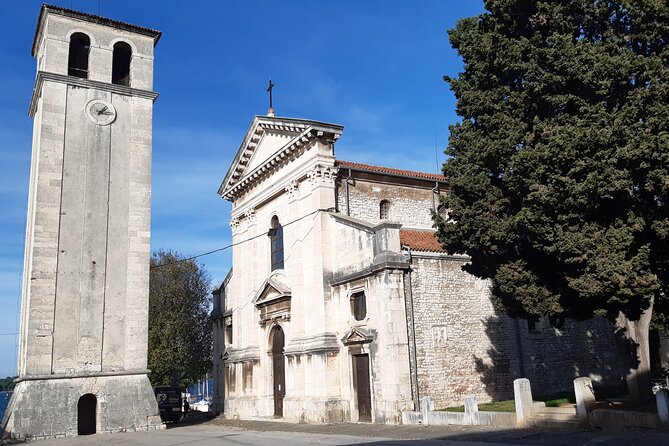
The next stop is Pula Cathedral, dated to the 5th century AD. It’s described as the most important church in Pula, and the tour includes time walking to and around it.
This part is timed at about 10 minutes. If the cathedral is open, you’ll go inside. If it isn’t, you’ll still get the walking explanations around the exterior.
Why it matters on a Roman-themed walk: cathedrals like this often sit in layers—meaning the city kept evolving long after Roman times. Even when you’re focused on antiquity, it helps to see where later eras took root.
If you’re the type who likes to compare how different centuries reuse and reinterpret space, this stop quietly delivers.






Tempio di Augusto and the forum area: Augustus meets later city life
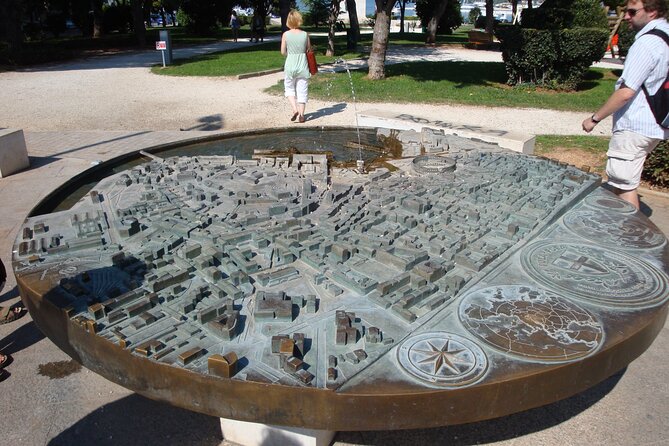
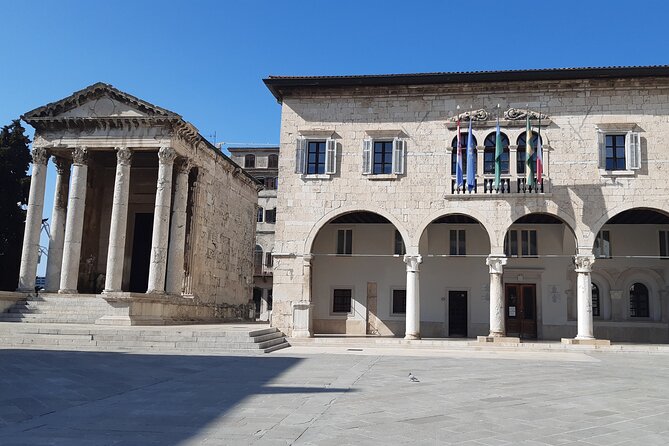
From the cathedral area, you head toward Tempio di Augusto, tied to the 1st century AD. This is part of the Roman forum zone with the Augustus temple, and the tour also references the city hall built in 1396.
Plan on about 15 minutes here, and the approach is walking around with explanations. Admission is listed as not included for this stop, but from the way the tour is structured, you should think of it as a guided “what you’re looking at” session rather than a long ticketed museum detour.
What you gain: Roman forums can feel like scattered stones if you don’t have the story line. A guide gives you a mental map—what was civic space, what was worship space, and how the city’s later buildings interact with the earlier footprint.
The Punishment of Dirce mosaic: Roman art at floor level
Then comes one of the most “stand and really look” moments: the Floor mosaic The Punishment of Dirce, dating to the 2nd century AD. This stop is short—around 10 minutes—but the subject and the location are exactly why it’s memorable.
You’re seeing a Roman mosaic that’s about more than decoration. Even if you don’t read every inscription, the mosaic format itself is a sign of how Roman homes/public spaces displayed stories and meaning at eye level—literally in the path of daily life.
Admission for this stop is listed as free, which is a nice bonus. And because it’s a floor mosaic, it rewards a slower moment: you’ll get more from 10 focused minutes than from rushing through a bigger interior.
Arco dei Sergi and the Roman city-gate feeling
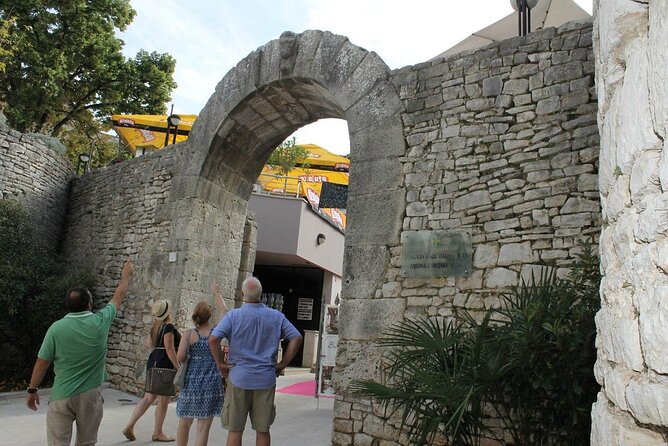
After the Dirce mosaic, you move to the Arco dei Sergi, a 1st century BC Roman city gate. The tour includes walking under and around it, with explanations about the decorations and inscriptions.
This is about 10 minutes, and it’s one of those stops where you feel the Roman city as a system: gates weren’t only entrances, they were statements. Even short stops like this can make the rest of the tour land better because you start recognizing patterns—arches, inscriptions, and the way power announces itself in stone.
Admission is listed as free here, so you’re not paying extra for the “photo + story” part.
Gate of Hercules and the Twin Gates: standing in the old entrances
The final stretch is built around remaining Roman city gates. You’ll visit:
- Gate of Hercules (about 5 minutes) from the 1st century BC
- The Twin Gates of Pula (about 5 minutes) from the 2nd century AD
These are quick, punchy stops. The value is less about time inside and more about standing in the places that controlled movement. With only a few minutes each, you’re not bogged down, which keeps the overall tour efficient.
And since the tour ends at the Twin Gate, you get a tidy wrap-up: you finish right where the Roman city’s entrance energy is still physically there.
Gradska Trznica Pula: market reality and a local rhythm
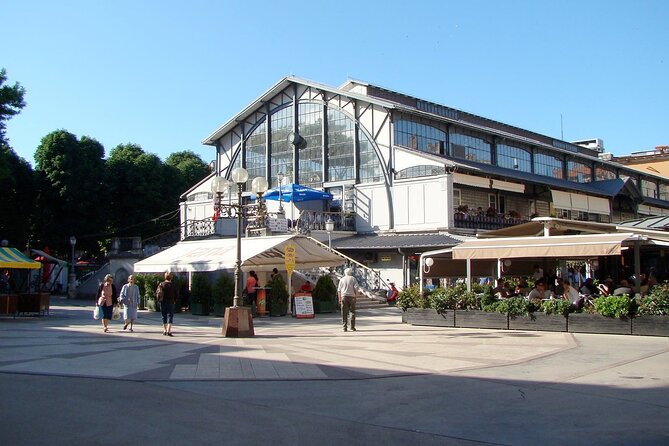
One of the best “day in Pula” additions is Gradska Trznica Pula, a market building from 1903. The tour includes 15 minutes walking around and through the market building, plus explanations.
If the fish market is open, you can visit it during the stop. Admission here is listed as free.
This is the part of the tour that breaks the pure-Roman pattern. It’s not just sightseeing; it’s how locals run errands, buy food, and keep the city grounded.
Practical note: markets can be noisier and warmer depending on the time of day and how busy it is. Still, it’s a smart way to end the tour with something real instead of another stone monument.
Walking comfort: hills, heat, and how the guide helps
This is a walking tour, and Pula has some uneven terrain and hills. The good news is your guide should manage pacing. One piece of feedback I liked: the guide was careful about the walking pace since there are hills, and people also took time to seek shade during very hot weather.
So if you’re booking for a summer day, treat this like an active sightseeing plan, not a slow stroll. Bring water, wear supportive shoes, and plan to use any natural shade you spot along the route.
Because it’s private, you can also ask for short breaks without feeling guilty or awkward. That’s one of the quiet advantages of going one-on-one.
Price and value for a small private group
The price is $145.50 per group for up to 15 people, for about 2 hours. That’s a pricing model that can work well if you’re traveling with family or a small crew. In practice, the guide time is the real cost—once you spread it across even a handful of people, the per-person value can look very reasonable for a tour that covers a lot of “major sights” in a compact walk.
One trade-off: not all admissions are included. The amphitheater has an additional €10 per person fee if you decide to enter. Cathedral, the Dirce mosaic, and the gates/arch/market stops are listed as free admissions in the tour details.
So your value equation is simple:
- If you want to enter the Amphitheatre, expect an extra per-person cost.
- If you’re happy with outside explanations there, you can keep it closer to the base price.
Given how much attention the amphitheater gets on the route and the advantage of having ticket help, it often pays off if amphitheater entry is on your list.
Final verdict: should you book this Pula private walking tour?
Book it if you want an efficient, English-led walk that covers the Roman highlights plus a market stop, with a resident guide who knows how to explain what you’re seeing without dumping information on you. This works especially well if you’re short on time and still want a connected storyline—from the Arena to Augustus-era spaces to the gates and mosaic details.
I’d hesitate only if you hate walking in midday heat or you need a fully accessible, minimal-step schedule. The tour is designed for moderate physical fitness, and the route includes hills.
If you’re the type who likes to ask questions and steer the pace, you’ll likely enjoy this one. And if your guide is Sinisa (name seen in the feedback), you can expect a friendly, funny, professional style—and that practical habit of making logistics feel less annoying so you can focus on Pula.
FAQ
How long is the Pula Private 2-Hour Guided Walking Tour?
The tour lasts about 2 hours.
Is this tour private?
Yes. It’s a private tour/activity, and only your group participates. The price is listed per group (up to 15).
What language is the tour offered in?
The tour is offered in English.
Where do we meet and where does the tour end?
Meet at Pula Arena (Flavijevska ul.) and end at the Twin Gate (Carrarina ul. 8).
Is the Amphitheatre de Pula entrance fee included?
No. Amphitheatre de Pula admission is not included and is listed as €10.00 per person. The guide can buy entry tickets at the entrance if you choose to enter.
What if the Pula Cathedral is closed?
If the cathedral is open you will go inside. If it’s not open, you’ll still have walking time to and around it with explanations.
Do we need to pay for the mosaics and Roman gates?
The tour details list free admission for the floor mosaic (Punishment of Dirce), Arco dei Sergi, and the gates (Gate of Hercules and the Twin Gates). The amphitheater is the one with a specific listed admission fee.
What is the cancellation policy?
You can cancel for free up to 24 hours in advance for a full refund. Changes made less than 24 hours before the start time aren’t accepted, and refunds aren’t available if you cancel within 24 hours of the start time.